Can You Open a New Google Ads Account After a Suspension? How Google Links Accounts

Three connected account nodes, one crossed out in lilac and one new in mint, joined by a link symbol, on a dark navy ground
Google publishes what may happen to accounts opened after a suspension, and examples of the connections that make accounts related. What the policy text actually says about a new Google Ads account after suspension, how manager links and payments profiles connect accounts, and how to work through the account you already hold.

Your account is suspended, the notification email explains almost nothing, and somewhere in the first hour someone will suggest opening a new account and sorting the suspension out later. It is an understandable reaction to a bad morning, and it is conduct Google’s circumventing systems policy names as a violation. Google publishes what may happen to new accounts opened after a suspension, and it publishes examples of the connections that make accounts related. This article sets out what the policy actually says, the mechanism behind it, and what to do with the account you already have.

The short answer, and the policy text behind it

Google’s published rule carries a purpose qualifier, and it is worth putting it the way Google puts it: creating further accounts after a suspension in order to continue breaking Google’s policies is prohibited, and Google separately states that any new account the advertiser tries to create may also be suspended. A new account is therefore not a way of getting campaigns running again while the suspension is dealt with. It is exposed to the same enforcement, and it adds a second question to a situation that already has one.

Google’s circumventing systems policy states: “Multiple account abuse isn’t allowed under the circumventing systems policy. This means you can’t create multiple Google Ads accounts after getting suspended to try to get around Google Ads’ policies or show content that breaks Google Ads’ rules.” The policy lists “creating more accounts after getting suspended in order to continue breaking Google’s policies” as a direct example of the prohibited behaviour.

The enforcement wording matters as much as the rule. Circumventing systems sits inside Google’s abusing the ad network policies, where violations are described as egregious: accounts are “suspended upon detection and without prior warning”. There is no warning email.

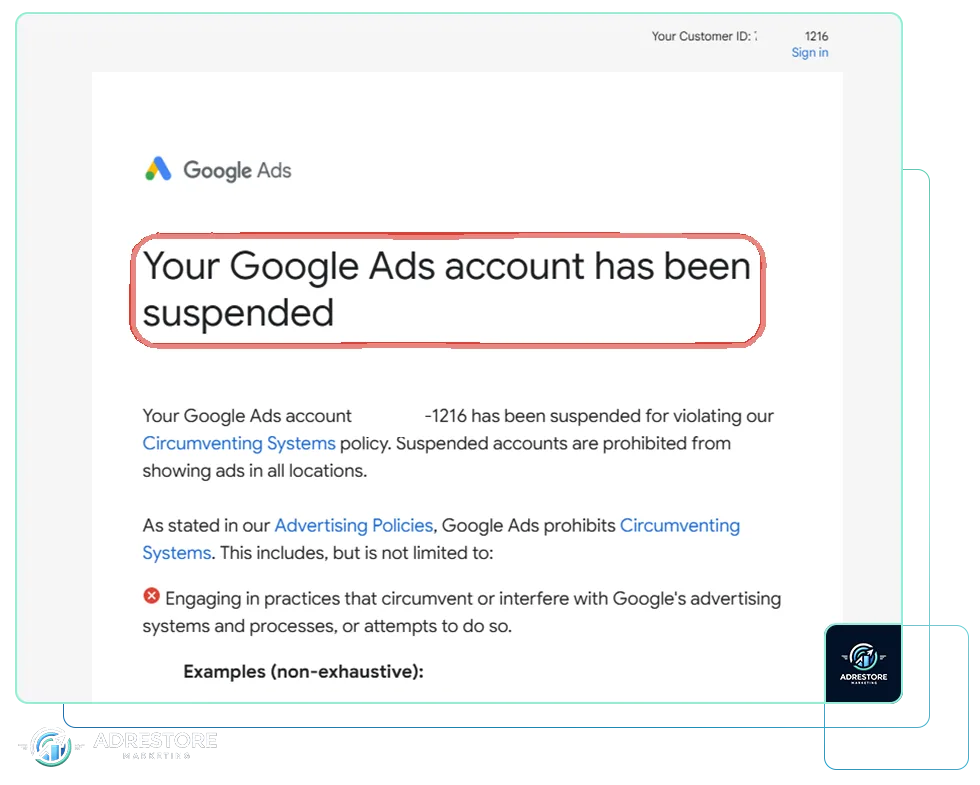
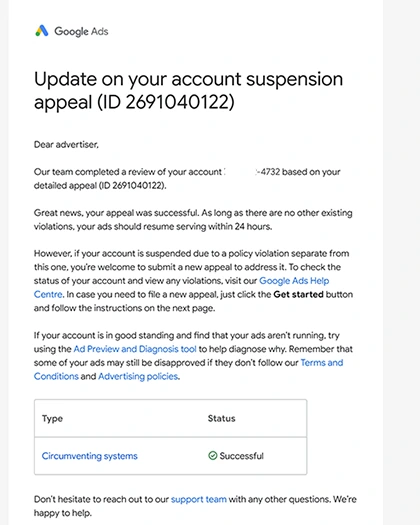
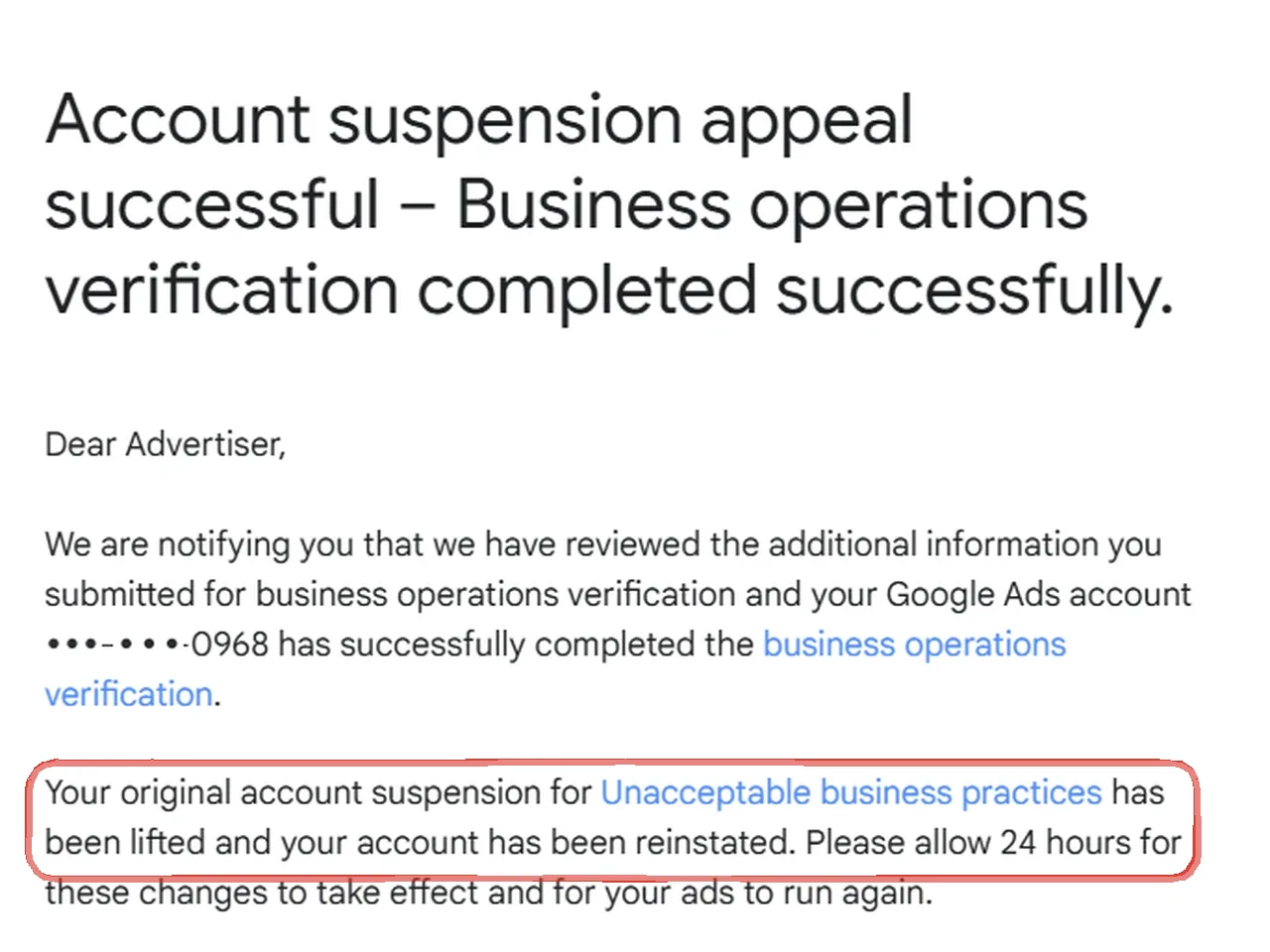
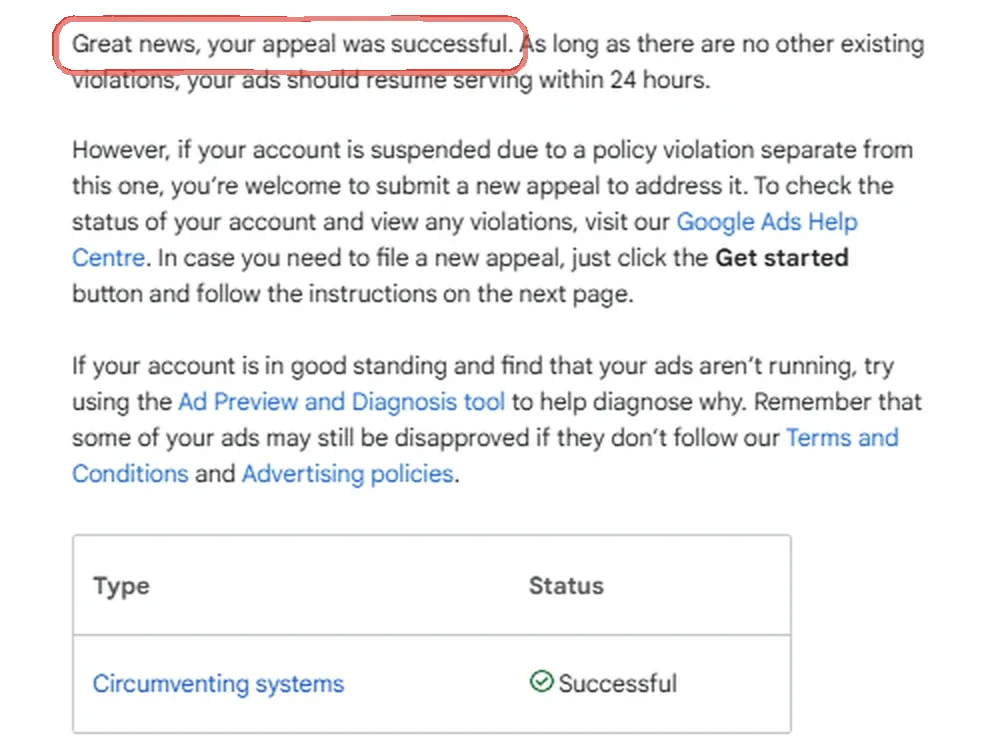
So the first practical step is to read the suspension notice properly and identify which policy Google actually named. If the notice already says Circumventing Systems, the account is in the category enforced without prior warning, and the response has to be an evidenced appeal rather than a fresh start. We cover what that finding involves, and how it is answered, on our Circumventing Systems Policy suspension page.

What Google means by a “related account”

Advertisers often assume a new account is a clean slate because it has a new login and a new campaign structure. Google’s own documentation says otherwise, and it gives examples. Its account suspensions overview states that “accounts related to the suspended account may be suspended”, and that “any new accounts that the advertiser tries to create may also be suspended.”

The examples of what makes an account related appear on Google’s billing and payment suspensions page, which is scoped to billing and payment enforcement and uses stronger wording in that context: “accounts related to the suspended account (for example, accounts using the same email or payment method, or accounts linked to the same manager account) will be suspended.” For the general case, the overview page above is the one to work from, and its wording is “may be suspended”.

Those three published examples cover more ground inside a real business than they appear to. The first column below is Google’s published wording. The second and third columns are our own checklist rather than Google’s, and they are there so a business can rule things out early instead of discovering them later. Interface labels change; the locations described are the relevant sections as of September 2026.

Signal Google publishes What to rule out in your own accounts Where to look
The same email address Any user or pending invitation on the account, at any access level, including addresses added years ago and no longer used day to day The user access section of each account’s admin settings
The same payment method A shared company card, a director’s card used to open an account, or a payments profile attached to more than one account The billing settings of each account and the cards saved on the payments profile behind it
Accounts linked to the same manager account An agency manager account, an in-house manager account, and any manager relationship that existed in the past The manager account listing in each account’s admin settings, plus any manager account you or a supplier control

The action here is a piece of admin nobody enjoys but everybody needs: write down every Google Ads account your business has ever touched, with its account ID, the email addresses on it, the payments profile behind it, and every manager account it is linked to or has been linked to. That account map is the document the rest of the process runs on.

Why a new account makes the original problem harder, not easier

A suspension is a finding. Findings can be wrong, they can be based on something that was fixed months ago, and they can rest on a misreading of a landing page, a billing change or a redirect. An appeal is the process for putting that evidence in front of a reviewer.

Opening a new account changes the question being reviewed. Before, the question was whether the original finding was correct. After, there is a second fact on the record that is not in dispute: an account was created after a suspension decision. It belongs to a policy category enforced on detection without prior warning. An arguable case becomes a more complicated one, and the new account is exposed to suspension as well.

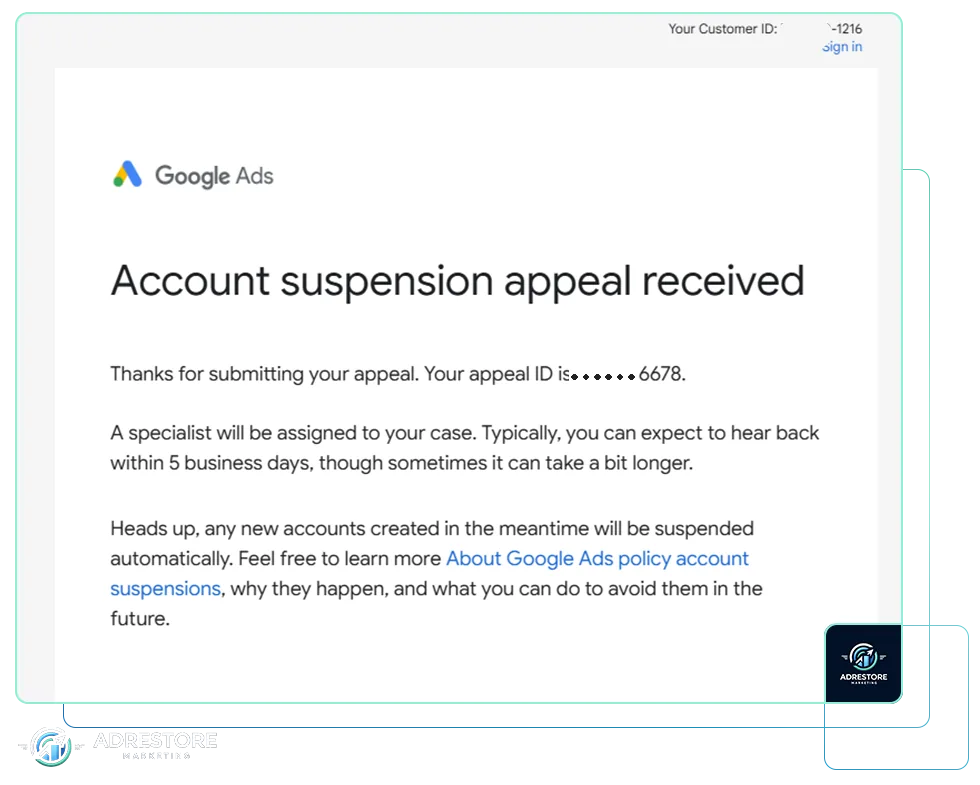
There is a second, quieter cost. Google’s account suspensions overview tells advertisers to correct the violation and to ensure that linked and related accounts comply with policy before appealing, so an appeal is asking a reviewer to accept that the underlying issue has been addressed. Our view is that a new account created in the meantime works against that account of events rather than for it. Our guide to Google Ads suspension appeal best practices goes through what a reviewer is being asked to accept, and why the sequence of events inside the account is part of it.

Manager accounts, agencies and inherited access

In the appeals I have worked on, a good number of the accounts were not opened by the business advertising from them. That creates situations that are genuinely difficult to unpick.

The account a previous agency opened

If an agency created the account under its own manager account, the history that produced the suspension may predate your involvement entirely. You still need to see it. Google’s page on ownership of client accounts confirms that a client account can only have one owner, that owner managers have “full administrative access and data access privileges”, and that the client account retains “the ability to remove ownership access by unlinking”.

The account you advertise from but do not own

Some businesses find at the point of suspension that they hold standard rather than admin access to their own advertising. Google’s access levels page reserves user management and advertiser verification for admin access; billing access, by contrast, can also add or edit forms of payment at payments profile level. Without admin access, a business cannot complete some of the steps an appeal depends on, including adding or removing users and completing verification.

The second account opened for a client already running elsewhere

An agency onboarding a client and opening a new account, while the client’s older account still exists and is suspended, has created the connection pattern the related-accounts examples describe. Whether or not anyone intended that, it is a risk worth identifying before an appeal is written rather than after.

What a business should do, in order:

  1. Establish who holds admin access on every account you advertise from, and get admin access in a business-controlled email address before you need it.
  2. Ask any current or former agency, in writing, for the account IDs and manager account IDs of every account they opened or managed for you, including ones that were closed.
  3. Where a manager relationship has genuinely ended as a commercial matter, complete the unlinking properly rather than leaving a dormant link in place. Unlinking is housekeeping, not concealment: it does not erase the history from Google’s records, Google’s own wording counts “previously linked” accounts, and the relationship still belongs in the appeal as disclosed context. Where the relationship has not ended, leave the link alone.
  4. Keep a written record of when access changed hands. It is the evidence that explains a history you did not create.

If you want that structure set up and run properly once the account is trading again, that is what our Google Ads management work covers.

Businesses that genuinely have more than one entity

Before anything else in this section: this is a test of accuracy, not of structure. If the honest answer is that one business operates one account, then one account is the correct answer. Nothing in this section applies to an advertiser with an account currently under suspension, and reorganising anything in response to enforcement is not what it describes.

With that said, multiple accounts are not forbidden. Franchise groups, holding companies and businesses with separately registered trading entities all have legitimate reasons to advertise from more than one account. Google’s requirement is stated plainly in the circumventing systems policy: “If you have multiple advertising accounts, make sure each account is connected to a real business.”

Read as an instruction, that means each account must be an accurate representation of the entity behind it:

  • A real, operating business sits behind the account, and the ads point to that business’s own site and offering.
  • The legal name and address on the payments profile match the registration documents for that entity. Google’s guidance on business operations verification gives, as one of the common reasons it lists for rejection, that “the organization name submitted doesn’t exactly match the full legal name on the business registration document, including any suffixes or punctuation”.

One further point is our recommendation rather than published policy: disclose the relationships between the accounts rather than leaving them to be inferred, including in an appeal. Google does not require that in the policy text. In our experience a reviewer reading a stated ownership structure is in a better position than one reconstructing it.

The pre-appeal requirement most people miss

Google’s account suspensions overview contains a sentence that quietly determines whether an appeal has any chance: “before appealing, ensure that all linked (or previously linked) and all related accounts comply with Google’s policies, as outlined in our Terms of Service.”

Note “previously linked”. An account that was unlinked from a manager two years ago still counts, which is precisely why unlinking is never a way of putting history out of view. And where several accounts are suspended, Google’s instruction on that same page is to “submit a separate appeal for each suspended account” with the context relevant to that account.

Practically, that means working through the account map before anything is submitted: confirming each account’s billing details are current and accurate, that its landing pages and ads meet policy today, that manager links reflect the real relationship, and that no account in the set contains an unresolved issue that will contradict the appeal.

An automatic remedy Google publishes

There is a published case where reinstatement does not require that account’s own successful appeal. On the same account suspensions overview, Google states: “if your account was suspended because other accounts verified using the same identity documents were suspended, your account will be automatically reinstated once those other accounts are successfully appealed.”

That is worth identifying early, because it changes the order of work. If one account is the origin of the finding and others were suspended by association through shared verification documents, the weight of the effort belongs on the originating account, with the shared-document relationship stated in the appeal. Google’s instruction to submit a separate appeal for each suspended account still stands wherever each account needs one; the shared identity documents case is the exception Google itself publishes. What does not work is copy-pasting a single appeal across the group, because each submission then ignores the facts specific to the account it is filed on.

What to do instead

  1. Appeal the account you have. It is the account the finding was made against, and the one where the evidence answering that finding sits.
  2. Fix the underlying cause first. Our practice is not to submit until the site, billing and business information have actually been corrected, so the appeal describes a situation that has already been put right.
  3. Keep the payment profile and entity details consistent. Where a change to a payment method or business name is genuinely necessary mid-process, we document it with dated evidence and explain it in the appeal rather than leaving it unexplained.
  4. Record every change with a date. Screenshots, invoices, registration documents and correspondence are what turn an assertion into something a reviewer can act on.
  5. Do not open anything new. Not a test account, not a second account for a related entity, and not an account opened while an appeal is pending. Our suspension services start from the account you already hold.

An illustrative scenario

The following is an illustrative example, not a client account.

An agency takes on a retail client and inherits an existing Google Ads account. Six weeks in, the account is suspended for Circumventing Systems. Nobody at the agency recognises the finding, because nothing they did explains it.

Instead of opening a fresh account, the agency builds the account map first. It asks the client for every account ID ever used and finds two: the live one, and an older account opened by a previous supplier that was suspended eighteen months earlier and forgotten. Both had at one point been linked to the previous supplier’s manager account, and both used a company card that was still saved on the client’s payments profile. The link between them was the payments profile and the historic manager relationship, exactly the connections Google describes.

Only after establishing that does anything get submitted. Admin access is moved into a business-controlled email address. The manager link to the previous supplier is unlinked, because that commercial relationship has genuinely ended, and the history of it is written into the appeal rather than removed from view: unlinking does not sever anything in Google’s records, and Google’s own wording counts previously linked accounts. The older suspension is addressed on its own terms with its own appeal. The appeal on the live account is written with the ownership history stated plainly rather than left for a reviewer to reconstruct. The order of that work is the whole point.

If you are deciding this today

The decision about a second account tends to be taken early, under pressure, before anyone has seen the full picture. It is worth slowing down for, because a new account carries its own exposure to suspension while doing nothing for the account that is already suspended.

If you are at that point, we offer a free consultation call to look at what was actually found, what the related-account picture looks like, and whether the suspension is realistically appealable. It is a conversation, not a pitch, and it is genuinely better had before anything new is created. You can book a call with us and bring your account IDs, the suspension notice and anything you know about who has held access.

Picture of Gianluca Catinella

Gianluca Catinella

Gianluca Catinella is the Director of Ad Restore Ltd. He has worked with businesses across a wide range of industries, managing high-spend Google Ads accounts and handling complex account suspensions — including some of the most challenging policy and reinstatement cases. His work covers Circumventing Systems Policy, Suspicious Payment Activity and Unacceptable Business Practices, along with advertiser verification, Merchant Center and Google Business Profile suspensions. He came to this work from the receiving end. Running Google Ads for his own first business, he had an account suspended and found almost no support available to explain what had actually been flagged or how to put it right. He spent the months that followed reading the policies properly — every suspension type, what reviewers look for, and what a successful appeal has to contain — and he now tracks Google’s policy changes as they ship. Automated enforcement has to cast a wide net to keep scammers and bad actors out, and legitimate businesses get caught in it. Gianluca’s job is the bridge from confusion to clarity: working out exactly which policy was triggered, fixing the underlying issue, and putting a clear, evidenced appeal in front of Google so the business can get back to trading.
Share this post

More from the blog

Leave a Review

Schedule a Consultation

Preferred contact method