Skip to content

The Google Ads Unacceptable Business Practices Policy: What It Covers, Section by Section
 Gianluca Catinella, Director, Ad Restore LtdPublished on 18 min read
Google Ads’ Unacceptable Business Practices policy bans scamming people by hiding or misrepresenting information about your business, products or services. It has three sections: the general policy with its four practices, phishing, and public figure impersonation. This guide covers what each one says, where the policy sits in Google’s documentation, and the clause about not having the right licences or qualifications that catches legitimate businesses, even though every example Google publishes is an outright scam.
If the suspension notice is already on your account, start with our guide to the notice and what to do next. If you’d rather we handled it, see our Unacceptable Business Practices appeal service.
If your account has been suspended under this policy, you are holding a notice that Google wrote for fraud. The examples on the policy page are a fake discount retailer, a fake charity, a fake property development, a fake email login page and an AI-generated video of a YouTuber endorsing a get-rich-quick scheme. If you run a trading business with real customers and real invoices, none of that describes you. Appealing it means closing the distance between what the policy illustrates and the clause it has actually caught you under.
Policy wording quoted in this article was checked against Google’s live help pages on 7 September 2026. Google restructured this policy twice in 2023 and 2024, so it is worth re-checking the quotes against the source links before you rely on them.
At a glance
Three areas
The general section, phishing, and public figure impersonation.
No warning
It is on Google’s list of egregious violations, so accounts are suspended without prior warning.
The licence clause
Offering what you can’t deliver includes “not having the right licenses or qualifications”.
Omission is enough
Obscuring or omitting material information about your identity, affiliations or qualifications is not allowed.
At least six months to appeal
Counted from the date of account suspension.
On this page15 sections
Where the policy sits in Google’s documentation
This policy is unusual in that it lives in three places at once, and each place tells you something the others do not. If you have not yet mapped how Google’s enforcement documentation is organised, our overview of understanding Google Ads suspension policies covers the wider structure.
Where the policy appears
| Where it appears | What it is | What it gives you |
|---|---|---|
| Unacceptable business practices (answer/15938071) | The standalone policy page | The operative bullets, the three sub-areas, the published examples, and the consequence wording |
| Misrepresentation (answer/6020955) | A named section inside the wider Misrepresentation policy | The neighbouring sub-policies published on the same page |
| Account suspensions overview (answer/9841640) | Google’s list of egregious violations | Why there was no warning, and the documented appeal route |
That third page is the one that explains the abruptness. Google states that “if we detect an egregious violation, we will suspend your Google Ads accounts immediately without prior warning”, and unacceptable business practices is on the published list of policies treated that way, alongside circumventing systems, counterfeit, malicious software and coordinated deceptive practices.
The three areas the policy covers
The general section is summed up in Google’s words: “Scamming people by hiding or misrepresenting info about your business, products or services isn’t allowed.” Four bullets carry the weight:
- “Make it seem like you’re affiliated with another brand, organization or government entity when you’re not”
- “Offer products or services that you don’t have or can’t deliver, including not having the right licenses or qualifications”
- “Lie about services that could put people’s health or safety at risk, like pretending to provide medical help when you don’t”
- “Impersonate other brands or businesses to get users to give you money or personal information”
Google’s illustrations of those bullets are “pretending to be a discount online retail store to entice people into buying products and then not delivering the items that they paid for”, “pretending to be or be affiliated with a well-known charity to deceive people into thinking they’re making donations”, and “tricking people into believing you’re the official website for a new real estate development so you can earn commission”.
Phishing
Phishing sits under the same policy: attempting to obtain personal information such as passwords or credit card numbers by posing as a trusted entity. The examples are a fake site imitating a well-known money transfer business, a fake email login page, and ads impersonating a widely known crypto exchange to steal private keys. If your notice names phishing rather than the policy in general, our guide to phishing in Google Ads covers what Google counts as phishing, the hacked-account route and what an appeal needs.
Public figure impersonation
The third area covers scamming people by claiming a connection to a famous person that does not exist. Google’s examples include using a singer’s image without permission to imply they are a happy client, falsely stating a professional athlete sponsors a weight loss product, and using AI-generated videos of popular YouTubers to imply an endorsement of a “get rich quick” scheme.
Read them together and the point is unmissable: every published example is fraud-shaped. Not one describes a business that simply documented itself poorly. In the appeals I have worked on, that is where the argument usually goes wrong. The business reads the policy page, concludes it cannot possibly apply, and then writes a submission rebutting a charge of fraud instead of answering the clause it was actually caught by.
The clause that actually catches legitimate businesses
Go back to the second bullet: “Offer products or services that you don’t have or can’t deliver, including not having the right licenses or qualifications.”
That clause has a history. Search Engine Land reported in September 2023 that Google was moving non-fulfilment of a product or service due to lack of qualifications out of the Misleading Representation sub-policy and filing it under Unacceptable Business Practices instead, with enforcement from 21 November 2023. A second update, reported in February 2024, added impersonating or falsely implying affiliation with or endorsement by a public figure, brand or organisation, with enforcement beginning in March 2024 for advertisers outside France.
The effect of that first move is easy to miss. A documentation failure that used to be handled as misrepresentation now sits inside a policy whose stated penalty is immediate suspension without warning. Three ordinary situations now fall within that wording:
- A trades business advertising work that is regulated or certified in the UK, whose website never states the registration or scheme number under which it operates.
- A clinic or professional practice whose landing page names a treatment or service but never names the practitioner, the registering body or the credential behind it.
- A retailer promoting stock and delivery it cannot readily evidence from the destination page — no dispatch terms, no returns policy, no company details.
None of those businesses set out to deceive anyone. All three are, on the face of the policy text, offering something they have not shown they are qualified or able to deliver.
The gap we see most often
The gap I see most often in cases that reach us is a registration or scheme number the business genuinely holds and can produce within minutes, sitting on a certificate in a drawer or in a trade body’s directory, and appearing nowhere on the pages the ads point at.
What Google means by misrepresentation
The controlling sentence is not about lying. Google’s Misleading representation sub-policy states: “Making misleading statements, obscuring, or omitting material information about your identity, affiliations, or qualifications is not allowed.” Omission is enough. Mismatch is enough. Three nouns carry it: identity, affiliations, qualifications.
The sub-policies published alongside it on the same page are worth quoting, because they describe website problems rather than ad problems:
- Inaccurate business name — “Providing an inaccurate business name or business name that does not clearly represent the advertised business or disambiguates from similar businesses in the ad or user interactions is not allowed.”
- Dishonest pricing practices — “failure to clearly and conspicuously disclose the payment model or full expense that a user will bear before and after purchase is not allowed”.
- Unreliable claims — “making inaccurate claims or claims that entice the user with an improbable result (even if this result is possible) as the likely outcome a user can expect”.
- Unclear relevance — “promotions that are not relevant to the destination”.
- Unavailable offers — “promising products, services or promotional offers in the ad that are unavailable or aren’t easily found from the destination”.
What enforcement under this policy looks like
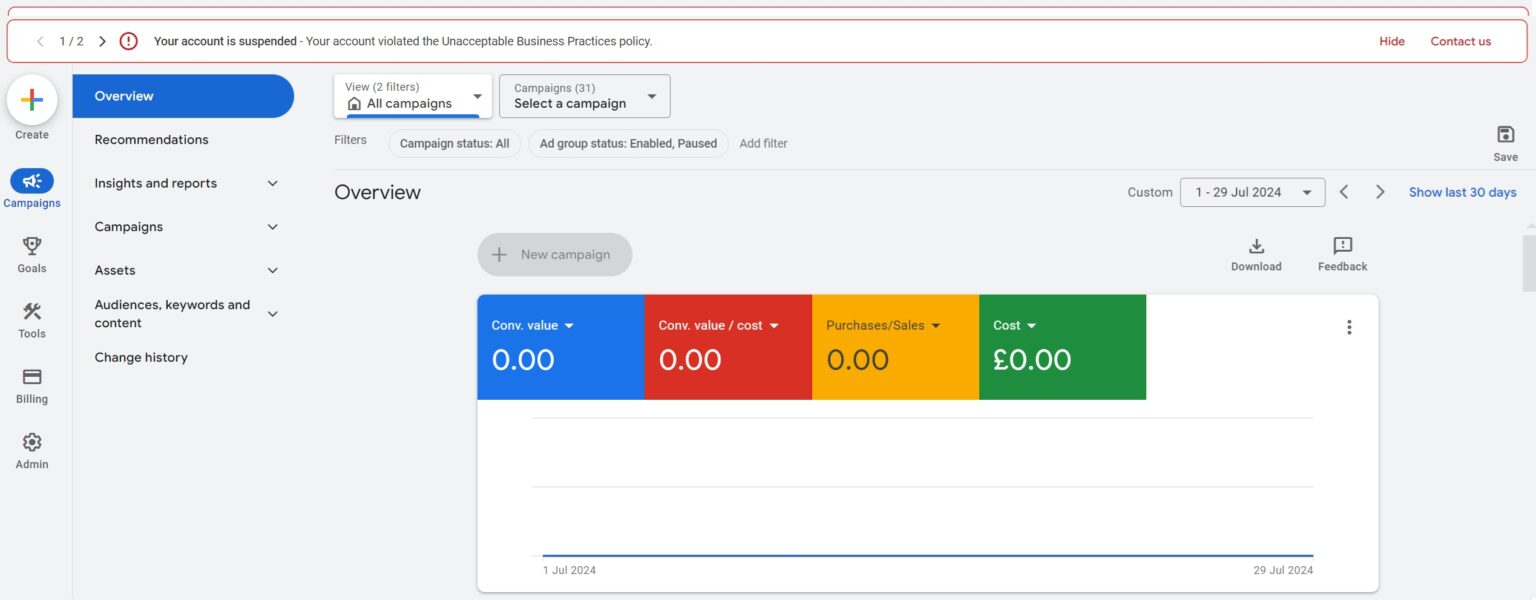
The in-account notification and the email that follows it are terse. In the accounts Ad Restore Ltd has worked on, the notice names the policy and stops there: no ad is identified, no page is identified, no clause is quoted. Google’s own name for it is the unacceptable business practices policy, and that name is usually the only thing an advertiser has to work from. Our guide to the suspension notice covers what the banner and email say, how to find the trigger and what to do in the first 48 hours.
Three things to do before you touch anything else:
- Screenshot the notification with the date visible. Google gives you at least six months from the date of account suspension to submit an appeal, and that clock starts on a date you will want recorded.
- Read the notice for a named sub-area. If it says phishing or public figure impersonation rather than the general policy, you are dealing with a different sub-page and a different evidence set.
- Freeze your website. Do not start deleting pages before you have a copy of what was live on the day of suspension. You may need to describe accurately what was published at the time.
Why an Unacceptable Business Practices appeal depends on the website
Every clause quoted above is written about the destination. Identity, affiliations and qualifications are things the policy text asks the destination to carry. An appeal narrative describing a legitimate business is easy to write, but it is not what those clauses are addressed to. Three policies converge on that page at once.
From Misrepresentation: unclear relevance, and unavailable offers that “aren’t easily found from the destination”. From the Destination requirements policy: destination mismatch, where the domain in the display URL does not match the final URL, or a redirect takes the user to a different domain; “destinations that aren’t crawlable by Google Ads” and destinations “that return an HTTP error code for Google AdsBot web crawlers on common devices globally”; insufficient original content, meaning content “replicated from another source without adding value in the form of original content or additional functionality”; and “destinations that are solely designed to send users elsewhere”.
The practical implication is blunt. If your site is not crawlable by Google Ads, or the evidence you intend to rely on sits behind a login, or your landing page is a thin bridge to a marketplace listing, the destination breaches a published requirement in its own right — separately from, and in addition to, whatever the suspension notice says.
A website transparency checklist
Most of what follows tracks a clause quoted above. Where an item is a recommendation of mine rather than a Google requirement, it says so.
What Google itself names as acceptable proof
Two of Google’s help pages are unusually specific about evidence, and they are the closest thing to a published list of what an appeal can contain.
The phishing page for this policy tells advertisers to use their own name, logo and images on the website and in ads; to ask a partner brand to mention the relationship on that brand’s own site as well as stating it on yours; and to keep contact information updated with a clear explanation of what the company does.
The public figure impersonation page goes further, naming contracts, written agreements, a link to a credible news article describing the connection, and public statements such as a social media post from the figure confirming the partnership.
Read as a set, those pages describe documentary, third-party-verifiable proof of identity and relationships. That is the register an appeal should be written in. The submissions I am asked to look at after a rejection are usually written in the opposite register — how long the business has traded, how many customers it has, how unfair the suspension feels — with nothing in them that anyone outside the company could check.
Verification is often part of the same problem
Advertiser verification and business operations verification often run alongside a suspension of this kind in the cases we handle, and they fail for reasons that overlap with the policy clauses above. Google publishes the failure reasons: information inconsistent with your documents or your account, organisation or individual names that do not match the documents exactly, address mismatches, a website that is invalid or not associated with the account, business relationships identified but not sufficiently explained, unclear information about who actually provides the goods or services, missing registration or industry licence documents, and illegible files.
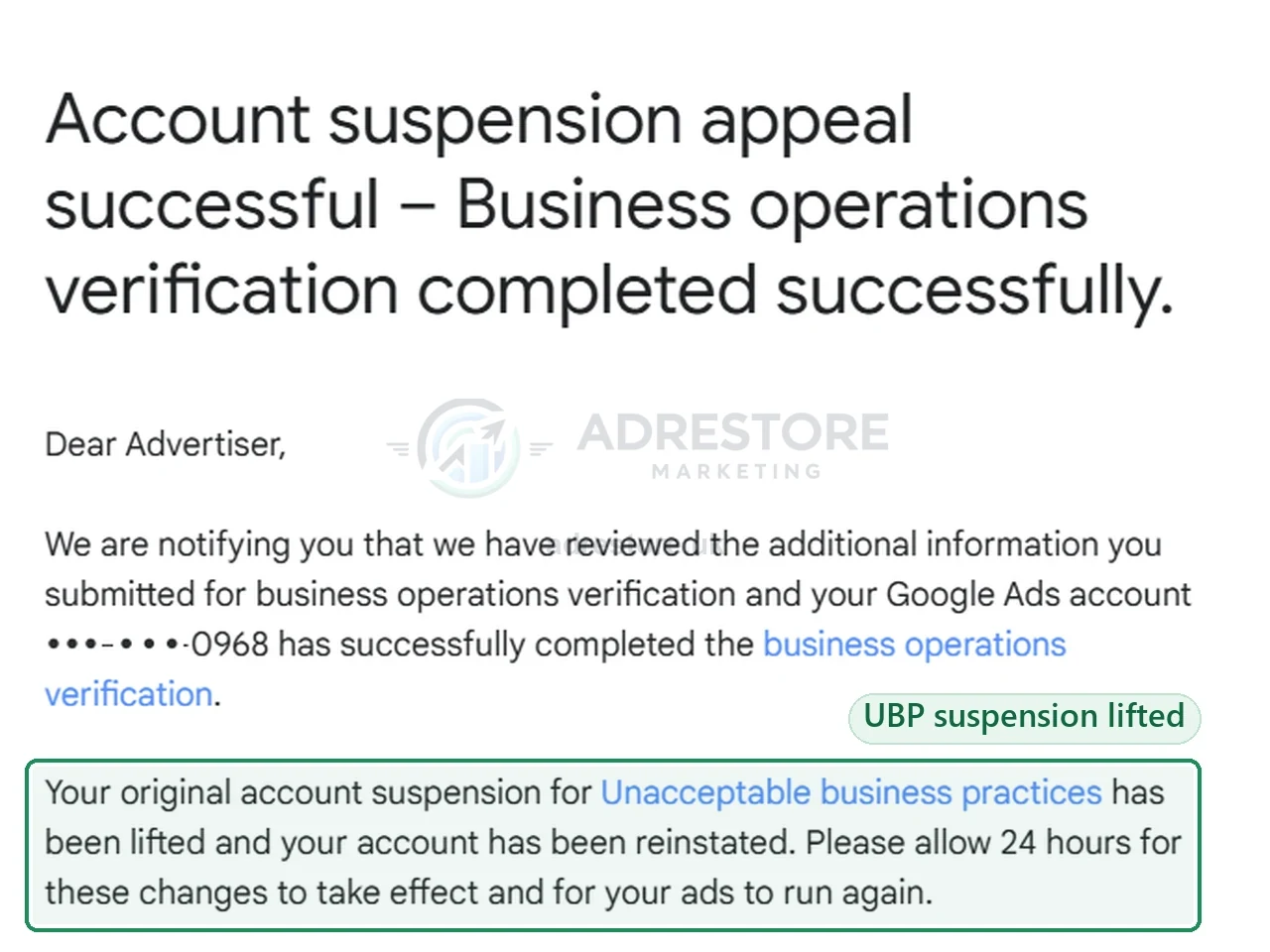
For UK advertisers, the document requirements for an organisation account are a registration document — certificate of incorporation, VAT registration certificate or certificate of registration of charity — plus government-issued photo ID for an authorised representative. Google’s instruction is exact: “make sure that the details in the submitted documents exactly match your payments profile info, including the organization name, if applicable”. A trading name in the payments profile against a registered company name on the certificate is exactly the kind of mismatch that instruction rules out.
Why there was no warning before an Unacceptable Business Practices suspension
Google’s own wording on this policy is severe: “your Google Ads accounts will be suspended upon detection and without prior warning, and you will not be allowed to advertise with Google Ads again”. That sentence is Google’s, and it is the reason so many advertisers assume the account is finished. It has to be read next to what Google publishes in the same breath — a documented appeal route, with accounts reinstated “in compelling circumstances, such as in the case of a mistake”.
Two of Google’s own publications give that some context. Google’s 2025 Ads Safety Report states that it “suspended 24.9 million accounts” over the year covered. And on 13 November 2025, Keerat Sharma, VP and General Manager of Ads Privacy and Safety, wrote that Google has “reduced incorrect account suspensions by over 80%”, with appeals addressed 70% faster and 99% resolved within 24 hours. The reading of that is narrow: Google concedes that incorrect suspensions exist and says it has been working to reduce them, which is context for why an appeal is worth preparing properly. It is not a prediction about any individual account, and nobody can offer you one.
The brand-new account suspended before it ever served an ad
A pattern that recurs in the accounts brought to us is a suspension under this policy on an account with no spend, no impressions and sometimes no live ad — created, verified, and suspended. That is our own casework rather than a published Google position, it is not a diagnosis of your account, and Google does not publish an explanation of it.
Don’t open a new account to get round a suspension.
If you already had an account and it was suspended, opening a fresh one to advertise from instead is itself a breach of the Circumventing Systems Policy, which sits on the same egregious list as this one. The route is appealing the account you have.
What matters is that a new account has no advertising history to point at, so everything it can evidence is external to Ads. That is a shorter list than it feels like: the registered entity and its filing record; the payments profile matching that entity exactly; a website old enough and complete enough to describe a real operation; a domain whose registration and history you can account for; and any prior relationship between the business, its directors and other advertising accounts, disclosed up front, not omitted. An appeal from a new account is a documentation exercise, not a performance history.
How the appeal route works
The policy page ends with Google’s route back. The short version is below; the step-by-step order, from fixing the site to the appeal form, is in our guide to the suspension notice, and our appeal service is there if you’d rather we did it.
Use the Contact Us link in the notification.
The route is the Contact Us link in the notification at the top of the suspended account. You have at least six months from the date of account suspension to submit.
Watch for “Appeal pending” and the email.
If you select Contact Us again while a submission is in progress, the account shows an “Appeal pending” status, and the outcome arrives by email.
If the appeal is rejected.
Filing repeatedly is counterproductive, and Google says so directly: where there are indications the appeals function is being misused, processing of certain appeals is suspended for seven days. One thorough submission, after the site has been fixed, beats four hurried ones. Our notes on Google Ads suspension appeal best practices go into how to structure the submission itself.
An illustrative scenario
This is an illustrative example written to show the sequence, not an account of a real client.
A services business operating under a regulated registration advertises to a landing page that describes the service well, quotes a price range, and carries a contact form. The registration number appears nowhere on the site. The company’s legal name appears only in the footer copyright line, in a shortened trading form. The payments profile carries the trading name; the certificate of incorporation carries the registered name. The account is suspended under the unacceptable business practices policy with no prior warning.
What changes before anything is submitted:
- the registration number and registering body are added to the landing page beside the claim they support;
- the full legal entity name, registered address and company number are published site-wide;
- the payments profile is corrected so it matches the certificate exactly;
- delivery, terms and cancellation pages are published and linked;
- and those pages are confirmed crawlable to Google Ads.
Only then is an appeal written, and it points to what the site now publishes rather than asserting that the business is legitimate.
Frequently asked questions
What does the Google Ads Unacceptable Business Practices policy cover?
Scamming people by hiding or misrepresenting information about your business, products or services. Google’s policy page has three sections: the general one, which bans implying an affiliation you don’t have, offering what you can’t deliver (including not having the right licences or qualifications), lying about services that put health or safety at risk, and impersonating other brands or businesses; phishing; and public figure impersonation. Google treats violations as egregious, so accounts are suspended without prior warning.
Is phishing part of the Unacceptable Business Practices policy?
Yes. Google’s policy page says “Phishing isn’t allowed under the unacceptable business practices policy”: trying to get people’s personal information, such as passwords and card numbers, by pretending to be a trusted or well-known entity. Our phishing guide covers it on its own.
What does Google mean by misrepresentation?
The controlling sentence is not about lying. Google’s Misleading representation sub-policy states: “Making misleading statements, obscuring, or omitting material information about your identity, affiliations, or qualifications is not allowed.” Omission is enough. Mismatch is enough. Three nouns carry it: identity, affiliations, qualifications.
Why was there no warning before an Unacceptable Business Practices suspension?
Google’s own wording on this policy is severe: “your Google Ads accounts will be suspended upon detection and without prior warning, and you will not be allowed to advertise with Google Ads again”. That sentence is Google’s, and it is the reason so many advertisers assume the account is finished. It has to be read next to what Google publishes in the same breath — a documented appeal route, with accounts reinstated “in compelling circumstances, such as in the case of a mistake”.
Why does an Unacceptable Business Practices appeal depend on the website?
Every clause quoted above is written about the destination. Identity, affiliations and qualifications are things the policy text asks the destination to carry. An appeal narrative describing a legitimate business is easy to write, but it is not what those clauses are addressed to.