Skip to content

Complete crypto certification – Google Ads
 Gianluca Catinella, Director, Ad Restore LtdPublished on 6 min read

The short answer.
Google Ads shows this notice when it reads your account as advertising crypto exchanges or wallets. If you don’t sell crypto, don’t apply for a crypto certification: none of the types fits a business that doesn’t offer them. In our experience, the fix is your website’s wording: say plainly what you do, and what you don’t.
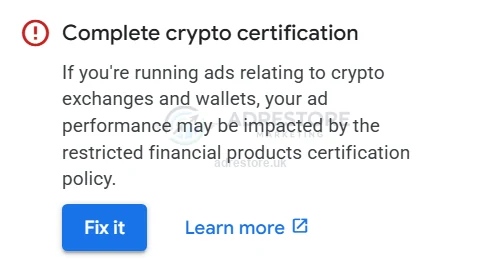
Complete crypto certification. If you’re running ads relating to crypto exchanges and wallets, your ad performance may be impacted by the restricted financial products certification policy.
The notification as it appeared in a client’s Google Ads account on 27 October 2026.
The notice names Google’s restricted financial products certification. Under its Cryptocurrencies and related products policy, Google says that if you meet the requirements and target only approved locations, you can apply to advertise restricted financial products. The “Fix it” button takes you towards that application.
The trouble is that the notice also reaches businesses that don’t sell crypto at all. This guide covers what it means, why it happens, and why applying is usually the wrong move.
Checked against Google’s help pages on 30 October 2026. Google changes them without notice, so check the linked page before relying on a detail. The client example is anonymised.
At a glance
It’s about crypto exchanges and wallets
Google restricts ads for exchanges, software and hardware wallets, and coin trusts.
Not every crypto mention needs it
Google allows businesses that don’t buy, hold or exchange crypto.
Licences by country
UK: FCA registration. EU: authorisation as a CASP under MiCA.
Don’t apply if you don’t fit
None of the types fits a payment provider, an agency or a software firm.
Fix the wording
In our experience, crypto language on the site is what triggers it.
On this page8 sections
What the notice means
Google’s Cryptocurrencies and related products policy splits crypto into three groups. Some products are allowed without an application, some are banned outright, and some are restricted: they can only be promoted in your ads once you’ve applied and been approved. The restricted group is:
- hardware wallets designed to hold the private keys for crypto assets;
- cryptocurrency exchanges;
- cryptocurrency software wallets;
- cryptocurrency coin trusts.
Approval also depends on where you advertise. Google lists approved locations, and for exchanges and wallets you must be a licensed provider of these products and services, with hardware wallets the exception. You submit a separate application for each location you want to target. Two examples from Google’s list:
- United Kingdom: ads for exchanges and wallets are allowed as long as the advertiser is registered with the Financial Conduct Authority (FCA).
- European Union: they’re allowed as long as the advertiser is authorized as a Crypto-Asset Service Provider (CASP) under the Markets in Crypto-Assets (MiCA) regulation by a national authority.
The certification types
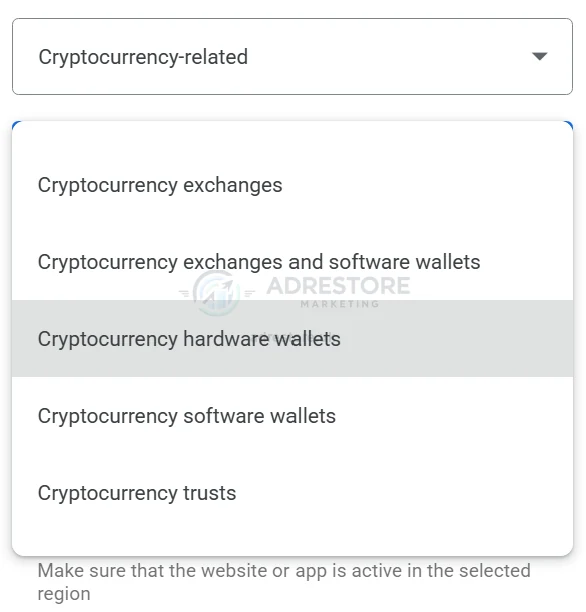
Since May 2026, Google says it will allow all advertisers to apply for the following certifications in their Google Ads account, including cryptocurrency exchanges and software wallets, hardware wallets and coin trusts. In the account, the application’s “Cryptocurrency-related” option lists five types:
- cryptocurrency exchanges;
- cryptocurrency exchanges and software wallets;
- cryptocurrency hardware wallets;
- cryptocurrency software wallets;
- cryptocurrency trusts.
Why businesses that don’t sell crypto get it
Google doesn’t need everyone near crypto to be certified. Its policy says Businesses that don’t pertain to buying, holding or exchanging cryptocurrencies are allowed, and its first example is Businesses that accept payment in cryptocurrency.
So why does the notice reach them? In our experience, it’s the language on the website. If your pages talk like a crypto business, Google reads you as one. Wording we’d look at first:
- crypto words used loosely, where the business itself doesn’t handle crypto;
- wallet or exchange imagery;
- “convert”, “on-ramp”, “off-ramp” and similar terms;
- anything that reads as if you buy, hold or exchange crypto for customers.
Why you shouldn’t apply for a certification you don’t fit
The “Fix it” button makes applying look like the answer. If you don’t offer the product, it isn’t. Applying for a crypto certification would claim a product you don’t offer, and none of the five types fits a payment provider, an agency or a software firm.
Google’s requirements make the same point. For exchanges and wallets, you have to be a licensed provider of those products in each location you target. A business that doesn’t run an exchange or a wallet can’t honestly meet that.
What to do instead
Say plainly what you do.
If you handle the fiat side only, say so, and say that licensed partners hold the crypto.
Say what you don’t do.
No exchange, no wallet, no buying, holding or exchanging crypto for customers.
Tone the language down.
Remove crypto wording and imagery that suggests a product you don’t offer.
Leave the certification alone.
Don’t apply for a type you don’t fit.
If the account is also suspended, get a specialist first.
Ask for a free quote, or email us, before you file anything.
If Google has disapproved an ad and you believe it’s wrong, its policy page says you can appeal the policy decision directly from your Google Ads account.
A recent example
A regulated payments business that serves crypto companies, but holds no crypto itself, came to us with this notice in its account. Google’s application offered only the five crypto types, and the business offers none of them. In our view, the notice came from the website’s crypto wording, not from a crypto product, so the fix is the wording, not a certification.
That case is still open, so we won’t say more about it.
Don’t open a new account or payments profile to get round a suspension.
Google says any new accounts that the advertiser tries to create may also be suspended, and its appeal form page asks you not to create new accounts while you wait, as they will also be suspended.
Frequently asked questions
What does “Complete crypto certification” mean in Google Ads?
It means Google reads your account as advertising crypto exchanges or wallets, which are restricted under its Cryptocurrencies and related products policy. Ads for them need an approved certification for each location, and the notice warns that your ad performance may be affected until then.
Do I need crypto certification if I don’t sell crypto?
No. Google’s policy says businesses that don’t pertain to buying, holding or exchanging cryptocurrencies are allowed, and gives businesses that accept payment in cryptocurrency as an example. If you got the notice anyway, in our experience the website’s crypto wording is the likely cause.
Which crypto certifications can you apply for?
In the Google Ads application, the Cryptocurrency-related option lists five types: exchanges; exchanges and software wallets; hardware wallets; software wallets; and trusts. For exchanges and wallets you must be a licensed provider in each location you target.
What licence does Google ask for in the UK and the EU?
For exchanges and wallets, Google’s policy says UK advertisers must be registered with the Financial Conduct Authority (FCA), and EU advertisers must be authorised as a Crypto-Asset Service Provider (CASP) under MiCA by a national authority. Other local laws apply too.
Should I apply anyway to make the notice go away?
Not if you don’t offer the product. Applying would claim a product you don’t offer. Change the website so it says plainly what you do and don’t do, and get a specialist if the account is also suspended.