Skip to content

“Counterfeit designer goods”: what a Google Ads account audit found for a football-shirt retailer – an open case study
 Gianluca Catinella, Director, Ad Restore LtdPublished on 16 min read
Due to Google policies, we're unable to provide specific details
Google Ads Support’s email to the retailer on 18 November 2025, quoted word for word. It named the Counterfeit Goods policy, but not the product.
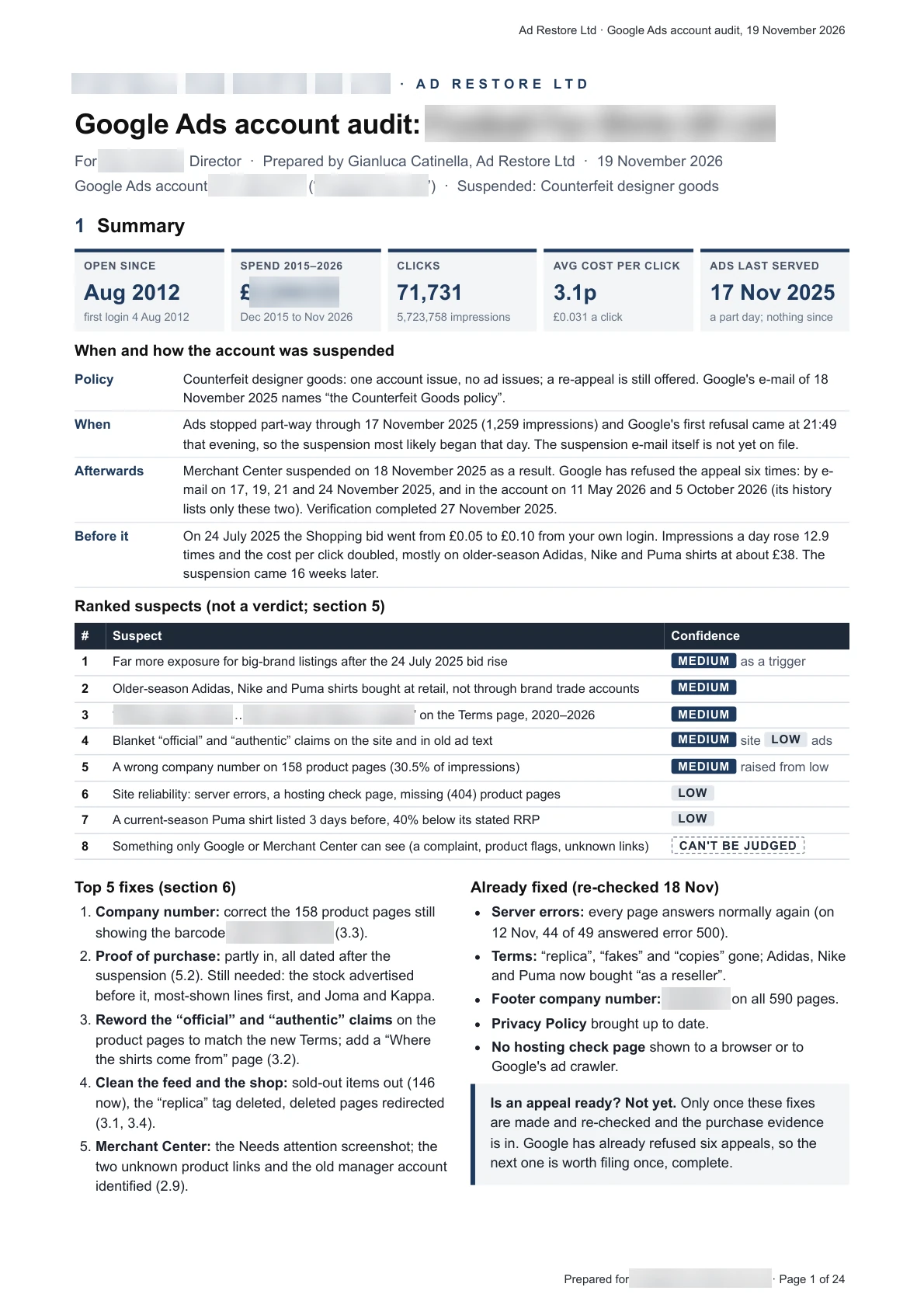
This is a real case, and it’s still open: a UK football-shirt retailer whose Google Ads account was suspended for “Counterfeit designer goods” in November 2025. Google refused its appeal six times and never said which product or page was the problem. In November 2026 the retailer asked for our £200 Google Ads account audit. This page shows what the audit read, what it found, and the four documents and the interactive timeline it handed over.
After reading the audit, the retailer asked us to handle the appeal. At the time of writing, 21 November 2026, the account is still suspended and the appeal is being prepared. Nothing has been filed yet, and the outcome isn’t known.
The audit is a diagnosis, not an appeal. It doesn’t name a cause, because Google doesn’t give one. It ranks the suspects, shows the evidence for and against each, and lists what to fix before anyone appeals again.
Written from the case file: the audit report, the two website reports and the timeline delivered on 19 November 2026, the account’s own screens and Google’s emails. The business, its website and its account number aren’t named, and identifying details are blurred in the screenshots. Google’s policy wording is quoted from its Counterfeit goods page, checked against the live page on 21 November 2026.
At a glance
Counterfeit designer goods
The policy the account names. Ads stopped part-way through 17 November 2025.
Six refusals
Four by email in November 2025, two in the account in May and October 2026.
Three parts
The account read through the Google Ads API, the website checked page by page, and a dated timeline.
Eight ranked suspects
None of them is a verdict: Google doesn’t say which product or page.
Open: appeal in progress
The retailer bought our appeal service on 20 November 2026. The account is still suspended, and no appeal has been filed yet.
On this page10 sections
The situation
The retailer sells new football shirts from many brands. Its Google Ads account has been open since August 2012, and almost all its advertising was one Shopping campaign: 98.6% of the account’s impressions, fed from its Merchant Center account.
The ads stopped part-way through 17 November 2025. In the account, the issue reads “Counterfeit designer goods”. The next day Google’s support team named the Counterfeit Goods policy by email, and said it was “unable to provide specific details”. Merchant Center was suspended on 18 November 2025 too, as a linked account.
Google’s Counterfeit goods policy describes counterfeits as “products that contain a trademark or logo that is identical to or substantially indistinguishable from the trademark of another”, which “mimic the brand features of the product in an attempt to pass themselves off as a genuine product of the brand owner”. The retailer had no idea what had triggered the suspension.
By the time of the audit, Google had refused the appeal six times: by email on 17, 19, 21 and 24 November 2025, and in the account on 11 May 2026 and 5 October 2026. The account’s own history lists only the last two.
What the audit covered
Our audit has three parts. Here is what each one read in this case.
The account, through the Google Ads API
We asked Google directly for access (we never ask for passwords), and on 18 November 2026 the account was read through Google’s official Google Ads API, with read-only access. Nothing in the account was changed. The read covered:
- every campaign since December 2015, where the account’s reporting begins, and the spend and traffic year by year;
- the daily figures around July 2025, and which brands were shown each month;
- the 641 products in the feed, and the 1,086 ad addresses on record;
- the users, the billing set-up and the linked accounts;
- the keywords, the 3,000 most-shown search terms of the six months before the suspension, and every ad text;
- the policy history.
Screenshots were taken inside the account the same day.
The website, page by page
A first website and domain review was done on 12 November 2026, before the account itself had been read: a deep scan of the domain and every subdomain we found, the pages a reviewer reads, and 26 product pages read in full. Older copies of the site in the Internet Archive were checked too.
On 18 November 2026 it was all checked again: 62 key addresses, then a sweep of 662 addresses, every product page on the site and every address the ads had used that was no longer listed. 21 Internet Archive copies of the Terms page were read, from 2020 to 2026.
The timeline
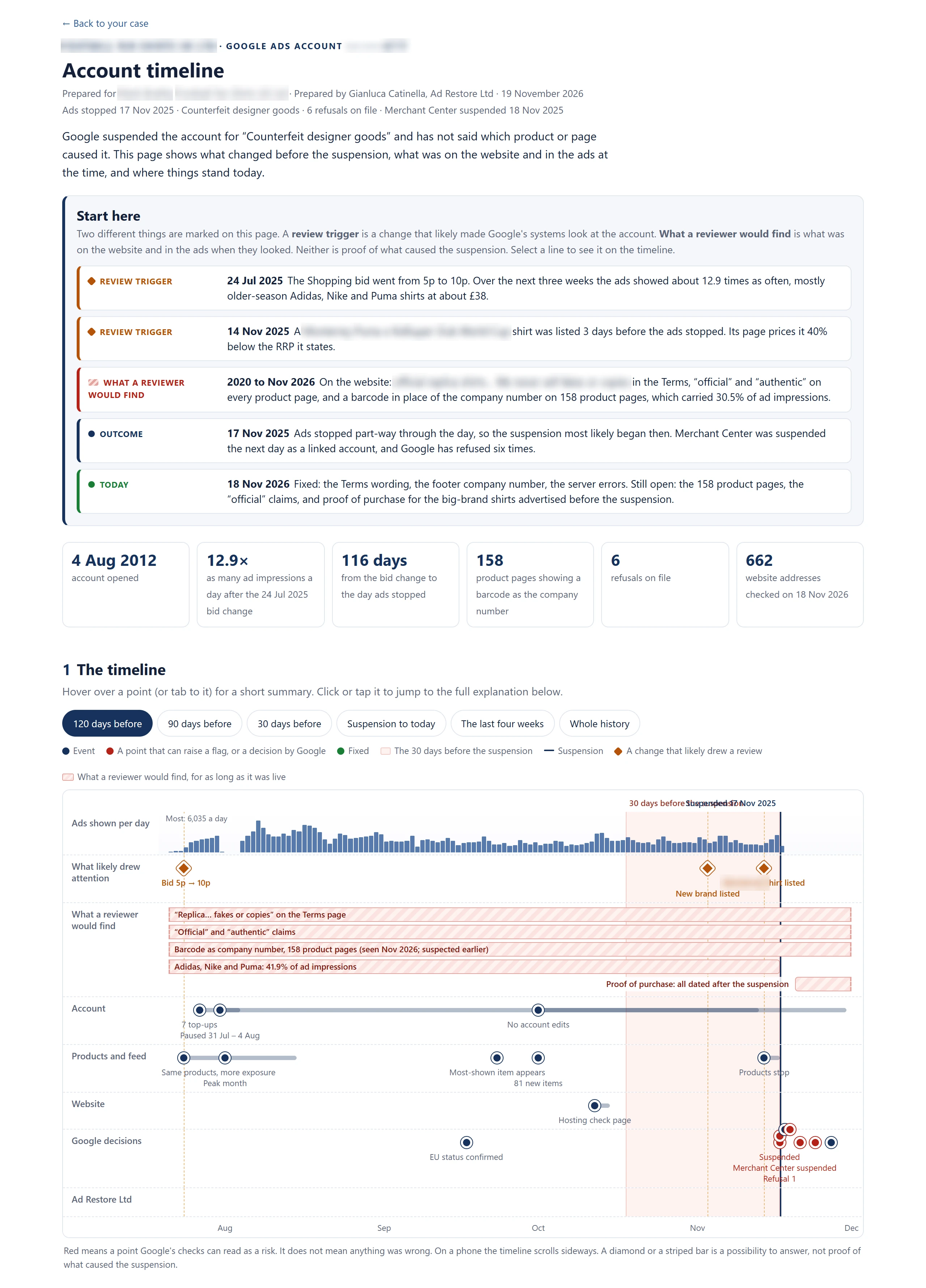
Everything with a date went on one page: changes in the account, products added to the feed, website changes, and Google’s decisions. It sets what changed before the suspension against what a reviewer would have found on the site at the time.
The retailer added what only the business could see: Google’s emails, Merchant Center screenshots, and receipts and trade documents for the stock, uploaded to the private client area.
What it found
Google doesn’t say which product or page caused a suspension, so the audit doesn’t name a cause. It ranks eight suspects, each with its evidence, what speaks against it, and a confidence. In the report’s words: “None of them can be said for certain to be the reason for the suspension.”
A bid change in July 2025
The account’s change history shows one change that mattered. At 12:28 on 24 July 2025, the bid on the Shopping campaign’s single “All products” group went from 5p to 10p, made by hand from the retailer’s own login. It was not a change Google applied automatically.
Over the next three weeks the ads were shown 12.9 times as often each day (235 impressions a day before, 3,022 after), and each click cost about twice as much. Adidas, Nike and Puma went from 34.8% to 46.6% of what was shown. The suspension came 16 weeks later.
The audit rates this medium as the thing that brought the account to attention, and low as a cause on its own: a higher bid isn’t a policy breach.
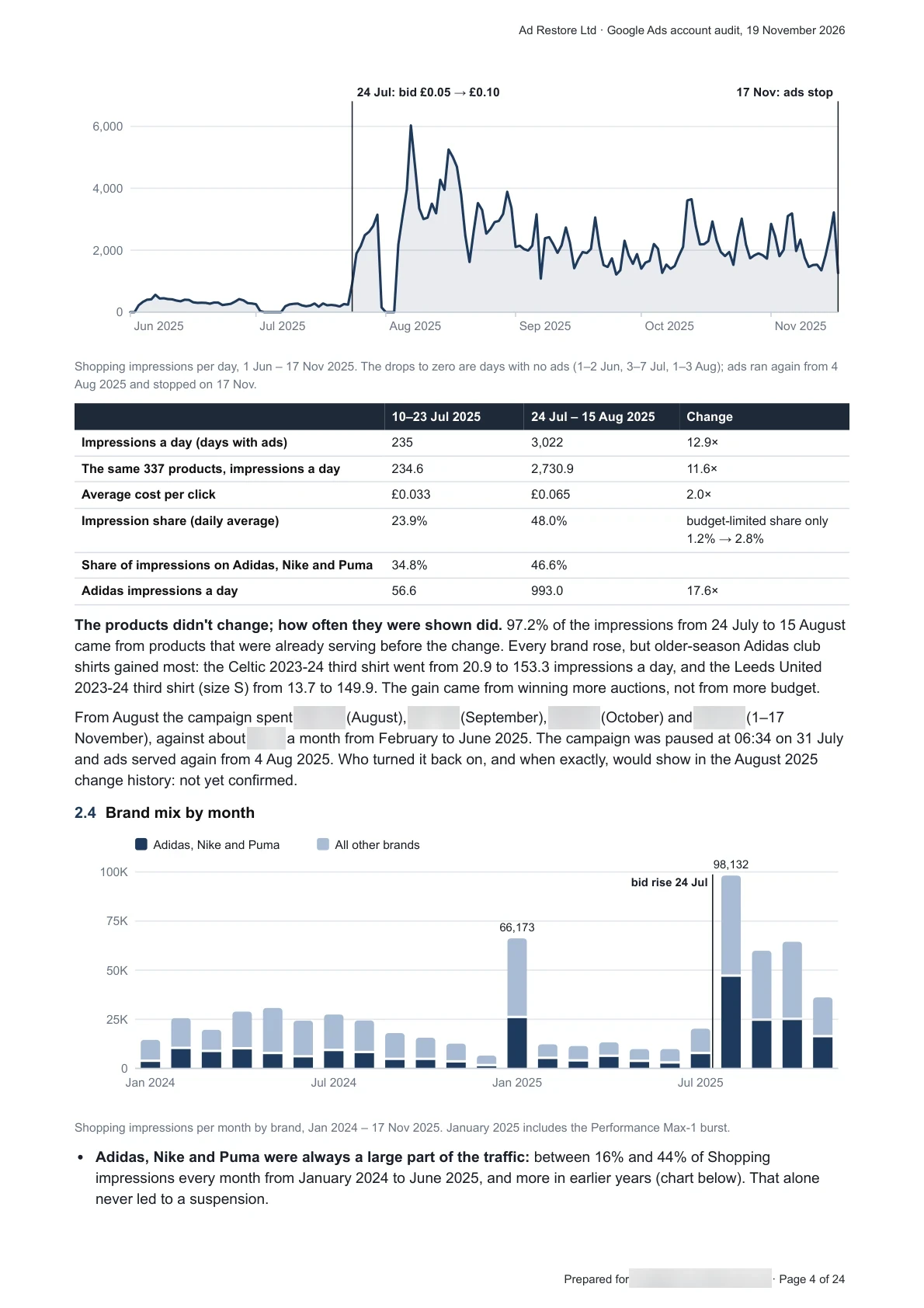
Big-brand shirts bought at retail
The products shown most in the six months before the suspension were Adidas, Nike and Puma shirts from the 2023-24 and 2024-25 seasons. The retailer buys those three brands at retail, not through brand trade accounts.
That profile was years old and had run without a suspension. The audit rates it medium all the same, as a standing weakness of the kind Google’s checks look for: well-known brands, past seasons, below launch price, and a seller who isn’t authorised by the brand. The receipts on file at the time of the audit were all dated after the suspension, and none covered the most-shown lines advertised before it.
“Replica” on the Terms page, next to a denial
The Terms page used the kind of words the policy lists. It described some of the shop’s shirts as “replica”, and the next sentence, a denial, used “fakes” and “copies”. The wording is in every readable Internet Archive copy from April 2020 to July 2025, and it was still on the live page on 12 November 2026. By 18 November it was gone.
The policy names these words when they sit next to a brand name: “Products described using terms like knock off, replica, imitation, clone, faux, fake, mirror image or similar terms when referring to a brand name in an attempt to pass themselves off as genuine products of the brand owner”. As the report puts it, even in a denial, “replica”, “fakes” and “copies” end up beside Adidas and Nike on the page. It had run for over five years without a suspension, so the audit treats it as a long-standing weakness, rated medium.
“Official” and “authentic” everywhere, “replica” beside it
“Official”, “authentic” or “genuine” was on all 519 product pages. In the account, a Search campaign from 2012 had ads saying “Official & Authentic Adidas”, and the same campaign held the keywords “+replica football shirts+” and “replica soccer jerseys”. A Performance Max campaign that ran in January and February 2025 told shoppers that authenticity was guaranteed.
All of that ad text and every keyword sat in removed campaigns, none of it was shown in the six months before the suspension, and none of the keywords had an impression since December 2015. But they stay on file, and Google can look at the whole account. The report’s point: “Official” or “authentic” in the ad and “replica” on the site is “exactly the mismatch a reviewer notices”. It rates the site claims medium and the old ads low, and suggests a plain disclosure for the site instead.
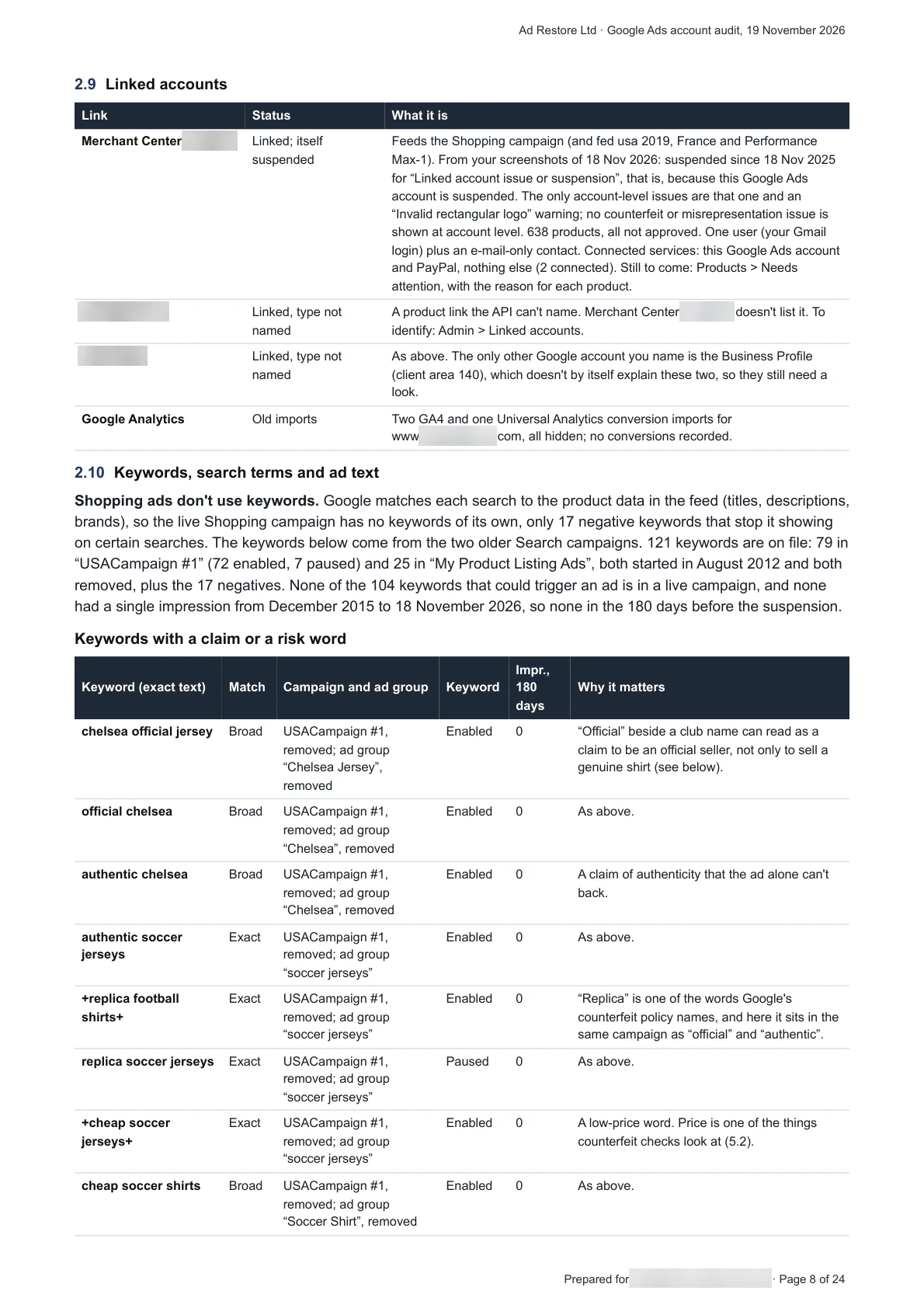
A barcode where the company number should be
158 product pages said “UK Company No.” followed by a 13-digit number that wasn’t the company’s number. It passes the check-digit test for an EAN-13 product barcode, so it was probably a barcode pasted into the company-number line. 96 of those pages carried ads: 30.5% of all the account’s impressions in the six months before the suspension.
The report’s reasoning: reviewers match the business on the site against the account and Companies House, and a wrong number on pages that carried nearly a third of the ad impressions is “an easy mismatch to remove”. Rated medium, raised from low once the full count was in. An early check had found it on six pages; checking every product address found 158.
What the data ruled out
Shoppers weren’t searching for fakes. Of the 3,000 most-shown search terms in the six months before the suspension, almost all were a team plus “shirt” or “kit”. “Replica” appeared in one term, with 12 impressions, and “fake”, “copy”, “knock-off”, “AAA” and “dupe” in none.
The July jump wasn’t new stock either: 97.2% of the impressions in the three weeks after the bid change came from products that were already being shown before it.
The eight suspects, ranked
- 1. Far more exposure for big-brand listings after the 24 July 2025 bid rise. Medium, as a trigger.
- 2. Older-season Adidas, Nike and Puma shirts bought at retail, not through brand trade accounts. Medium.
- 3. “Replica”, “fakes” and “copies” on the Terms page, 2020–2026. Medium.
- 4. Blanket “official” and “authentic” claims on the site and in old ad text. Medium on the site, low in the ads.
- 5. A wrong company number on 158 product pages (30.5% of impressions). Medium, raised from low.
- 6. Site reliability: server errors, a hosting check page, missing (404) product pages. Low.
- 7. A current-season Puma shirt listed three days before, 40% below its stated RRP. Low.
- 8. Something only Google or Merchant Center can see, such as a complaint, product flags or unknown links. Can’t be judged.
Merchant Center, and the six refusals
Merchant Center was suspended on 18 November 2025 for “Linked account issue or suspension”, because the Google Ads account was. From the retailer’s screenshots, no counterfeit or misrepresentation issue showed at Merchant Center account level, and all 638 products were “not approved”. The reason given for each product sits on the Needs attention tab, which was still to come.
The six refusals came through two email cases with Google Ads Support and two appeals in the account. The fourth came 27 minutes after the retailer’s reply. The report’s conclusion: “Google has already refused six appeals, so the next one is worth filing once, complete.”
What the retailer received
Four documents, and the interactive timeline in the private client area. All went to the retailer on 19 November 2026.
- The Google Ads account audit (PDF, 24 pages). The account read through the API, the website findings, the timeline, the eight ranked suspects and what to do next, with the evidence an appeal would need.
- The website and domain review (PDF, 9 pages, 12 November). The first look at the site and the domain, before the account itself had been read.
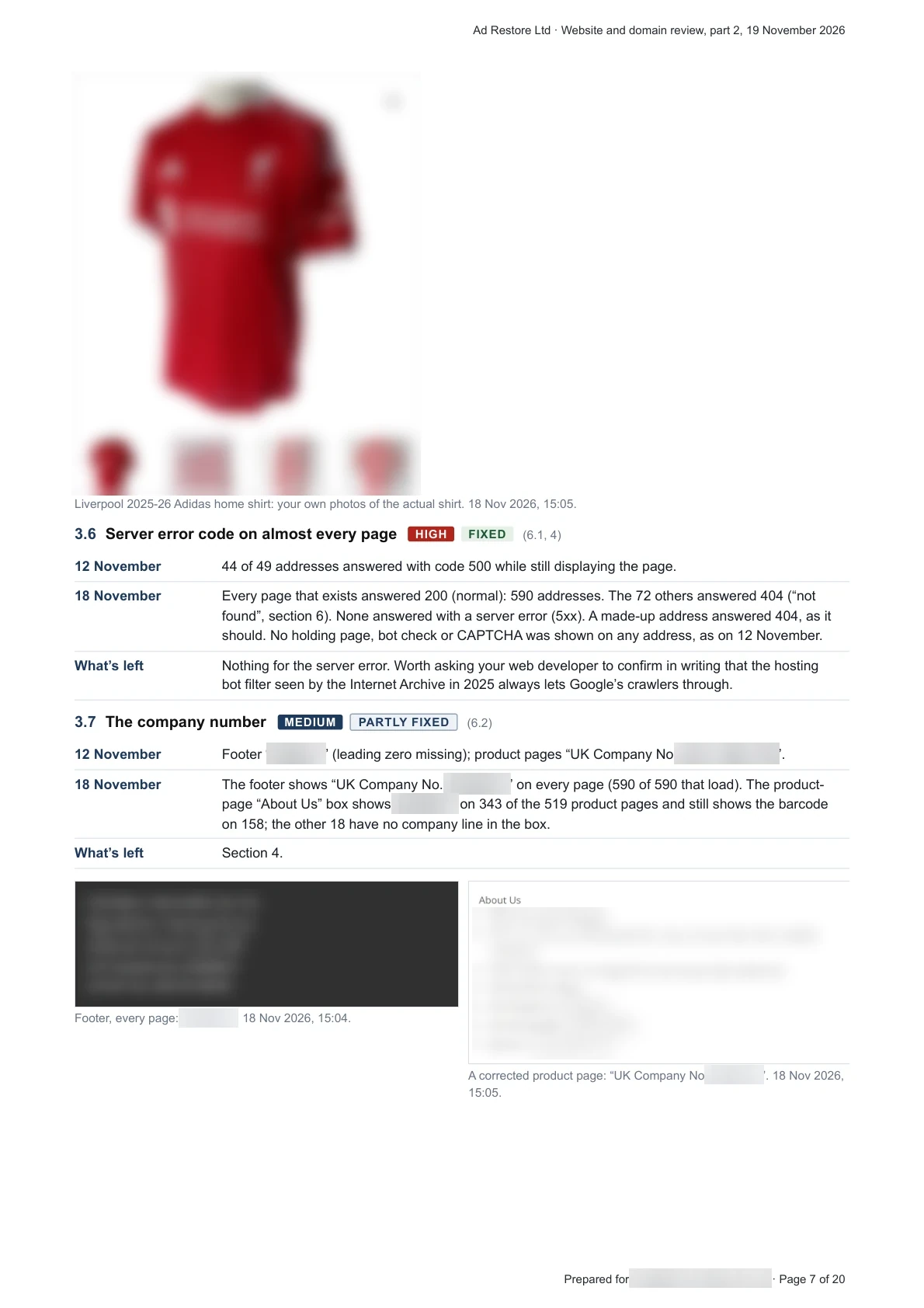
- The website review, part 2 (PDF, 20 pages). Every 12 November finding re-checked on the live site, the 662-address sweep, and full lists of the 158 barcode pages and the 72 missing pages.
- The account timeline (PDF, 15 pages). A printable copy of the timeline, with every detail opened.
- The interactive timeline, in the client area. Every dated event on one page, with a “Start here” box that separates what likely drew a review from what a reviewer would have found.
The fix list, in outline
The report ends with eleven fixes, each with who does it and when it counts as done:
Correct the company number.
On all 158 product pages, then search every product description for the barcode.
Decide on Nike, Adidas and Puma.
Keep them with proof of purchase, or take them off the site and out of the feed.
Proof of purchase for every brand on sale.
Starting with the stock advertised before the suspension, most-shown lines first.
Reword the “official” and “authentic” claims.
On the product pages, to match the reworded Terms, and keep them out of any new ad text.
Add a “Where the shirts come from” page.
The accounts by brand, how the other brands are bought, and invoices on request.
Clean the feed and the shop.
No sold-out items or missing images in the feed, the “replica” tag deleted, deleted pages redirected.
Merchant Center.
The one screenshot still missing: Products > Needs attention, with the reason for each product.
Identify the two unknown product links and the old manager account.
Each one named, or confirmed as not the retailer’s.
Smaller site fixes.
Among them, one returns wording that contradicted another.
Confirm the hosting bot filter always lets Google’s crawlers through.
A written confirmation from the web developer.
Re-check everything before an appeal.
A dated scan of the site and the feed showing items 1 to 10 closed.
By the re-check on 18 November, some things were already fixed: every page answered normally again (on 12 November, 44 of 49 addresses had answered with a server error), the Terms wording was gone, the footer showed the right company number on all 590 pages, and the Privacy Policy had been brought up to date.
Where things stand: open, appeal in progress
The report’s answer to “Is an appeal ready?” was: “Not yet. Only once these fixes are made and re-checked and the purchase evidence is in.”
After reading the audit, the retailer asked us to take on the appeal, and on 20 November 2026 it bought our appeal service. Since then:
- The website. The retailer took the “replica” tag off its products and corrected the company number. Our check of the live site on 20 November found no products under the “replica” tag, and none of the 262 products on sale showing the barcode as the company number. Sold-out product pages weren’t checked again that day.
- Proof of purchase. The retailer has started sending purchase records dated before the suspension, the main gap the audit found.
- The law as well as the policy. We’ve researched UK consumer and trade mark law on reselling branded goods, so the changes and the appeal follow both, and the retailer has a first outline of what needs to change.
- Merchant Center. The retailer’s Merchant Center account is now part of the work, alongside the Google Ads account.
The account is still suspended (checked on 21 November 2026), and no appeal has been filed yet. The outcome isn’t known, and we’ll update this page when Google decides, whichever way it goes.
That’s what the audit is for. It doesn’t include an appeal, and it changes nothing in the account or on the website. It gives what an appeal is built on: where the root causes most likely sit, the evidence, and the changes to make. Only Google decides whether an account is reinstated.
What this case shows
- A policy name isn’t a reason. The account said “Counterfeit designer goods”, and after six refusals Google still hadn’t said which product or page.
- Look further back than the weeks before. The account had no campaign, bid or budget change in the weeks before the suspension. The biggest change came in July: a bid that put the same shirts in front of far more shoppers.
- Wording can count against you even in a denial. A sentence saying the shop never sold fakes still put “fakes” and “copies” beside the brand names.
- A sample proves only the pages sampled. An early check found the barcode on six pages. Checking every product address found 158.
- Proof of purchase has to cover what was advertised. Receipts dated after the suspension don’t show where the earlier stock came from.
Don’t open a new Google Ads account to get round a suspension.
Our guide explains why a new account makes things worse.
Questions people ask
What does Google mean by counterfeit goods?
Its Counterfeit goods policy describes them as “products that contain a trademark or logo that is identical to or substantially indistinguishable from the trademark of another”, which “mimic the brand features of the product in an attempt to pass themselves off as a genuine product of the brand owner”. It also names wording such as “replica”, “fake” and “imitation” when used about a brand name in that way.
Did the audit find what caused the suspension?
It can’t, and it doesn’t claim to: Google doesn’t say. It ranked eight suspects with the evidence for and against each. The strongest were rated medium, and the report says none of them can be said for certain to be the reason.
Does the audit include an appeal?
No. The audit is the diagnosis: where the root causes most likely sit, the evidence, and the changes to make. Writing and filing an appeal is a separate service. In this case the report advised holding any appeal until the fixes were made and checked, and the retailer then asked us to handle the appeal.
Was the account reinstated?
Not at the time of writing, 21 November 2026: the account is still suspended. The retailer has since bought our appeal service, and the appeal is being prepared. Nothing has been filed yet. This page will be updated when Google decides.
What did the business have to send?
The things only the business can see: Google’s emails about the suspension and the appeals, Merchant Center screenshots, receipts and trade documents for its stock, and answers to nine questions, all through the private client area.