Skip to content

“Government documents and official services”: what a Google Ads audit found for a benefits-claim service – an open case study
 Gianluca Catinella, Director, Ad Restore LtdPublished on 13 min read
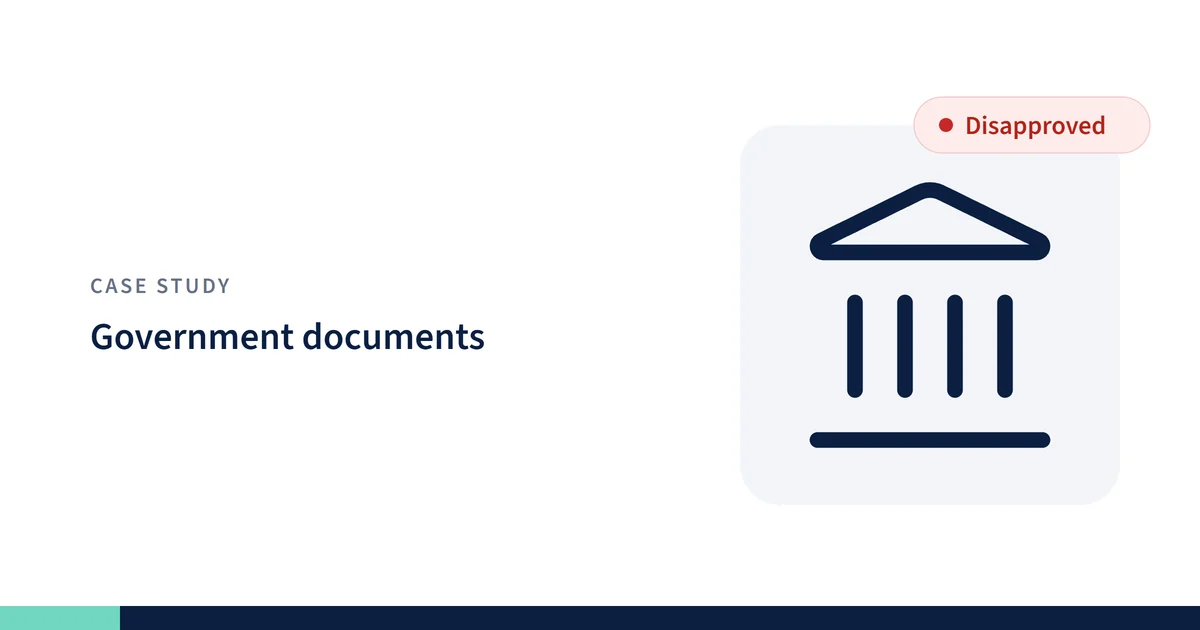
Certificate required: Government documents and official services
The label on Google’s disapproval emails to the business in August and October 2026, quoted word for word. It named the policy, but not what in the ads had triggered it.
This is a real case, and it’s still open: a UK company that charges a fee to help people claim state benefits kept having its Google Ads disapproved. The account wasn’t suspended. On 31 October 2026 the business asked us which policy really applied, whether Google offered a certification or exclusion route, and how to advertise within the rules, and it was clear it didn’t want a way round them. Our £200 Google Ads account audit answered those questions. This page shows what the audit read, what it found and what it recommended.
The audit was delivered on 4 November 2026. What the business does next is its decision, and the case is open.
The audit is a diagnosis, not an appeal. Where Google’s rules leave no route, it says so.
Written from the case file: the 24-page audit report and its appendix delivered on 4 November 2026, the account data read on 3 November 2026, and the Google emails and questions the business sent. The business, its website, its people and its account number aren’t named, and identifying details are blurred in the screenshots. Google’s policy wording is quoted from its Government documents and services page, its Other restricted businesses page, its October 2026 update and its Circumventing systems page, checked against the live pages on 21 November 2026.
At a glance
Government documents and official services
The policy on every disapproved ad and sitelink but one, with the label “Certificate required”.
Disapprovals, not a suspension
The account was enabled, with no account-level restriction. Three ads and eight sitelinks were disapproved under this policy.
Every ad, asset and keyword
Read through the Google Ads API with Google’s decision on each, plus the website and every page the ads used.
No route found
For ads promoting paid help with benefit claims, the audit found no certification or exclusion route under Google’s current rules.
Open
The audit was delivered on 4 November 2026.
On this page9 sections
The situation
The business charges a fee to help people prepare and submit claims for state benefits. Its website said clearly that it was an independent, paid service and not a government body, showed its fee, and pointed to the free official and charity routes first.
From August 2026 Google disapproved ads in several of its new Search campaigns under its Government documents and official services policy. Google’s emails, on 9 and 24 August and 8 October, named the policy and the label “Certificate required”. A 2025 ad had also been disapproved, for Misleading content. Nothing had run since 29 September 2026.
The business asked us four things: which policy really applied, as it wondered whether it was being treated as a financial service; whether these were ad disapprovals or an account-level restriction; whether a certification or exclusion route existed; and whether its application to the Financial Conduct Authority (FCA) would change anything. It wanted the rules resolved properly, not a new account or a way round them.
What the audit covered
Access was granted for the audit, and on 3 November 2026 the account was read through Google’s official Google Ads API, with read-only access. Nothing in the account was changed. We never ask for passwords. The read covered:
- all six campaigns, back to the first in September 2025, with spend and traffic by period;
- every ad, headline, description, sitelink and logo, with Google’s decision on each;
- all 97 keywords, and the searches people made;
- the landing pages, conversion tracking, settings and linked accounts;
- the change history.
The website and every page the ads used were checked the same day, and ten pages were captured in full. Google’s help pages, the official benefit pages and Google’s Ads Transparency Center were read too.
We also checked the business’s public records, and whether it held, or had applied for, Google’s certificate for this policy or an exclusion. It hadn’t applied for either.
What it found
Google gave no evidence for any of its decisions in this account, so where the report explains why, it’s the report’s reading of the account and Google’s rules, and it says so.
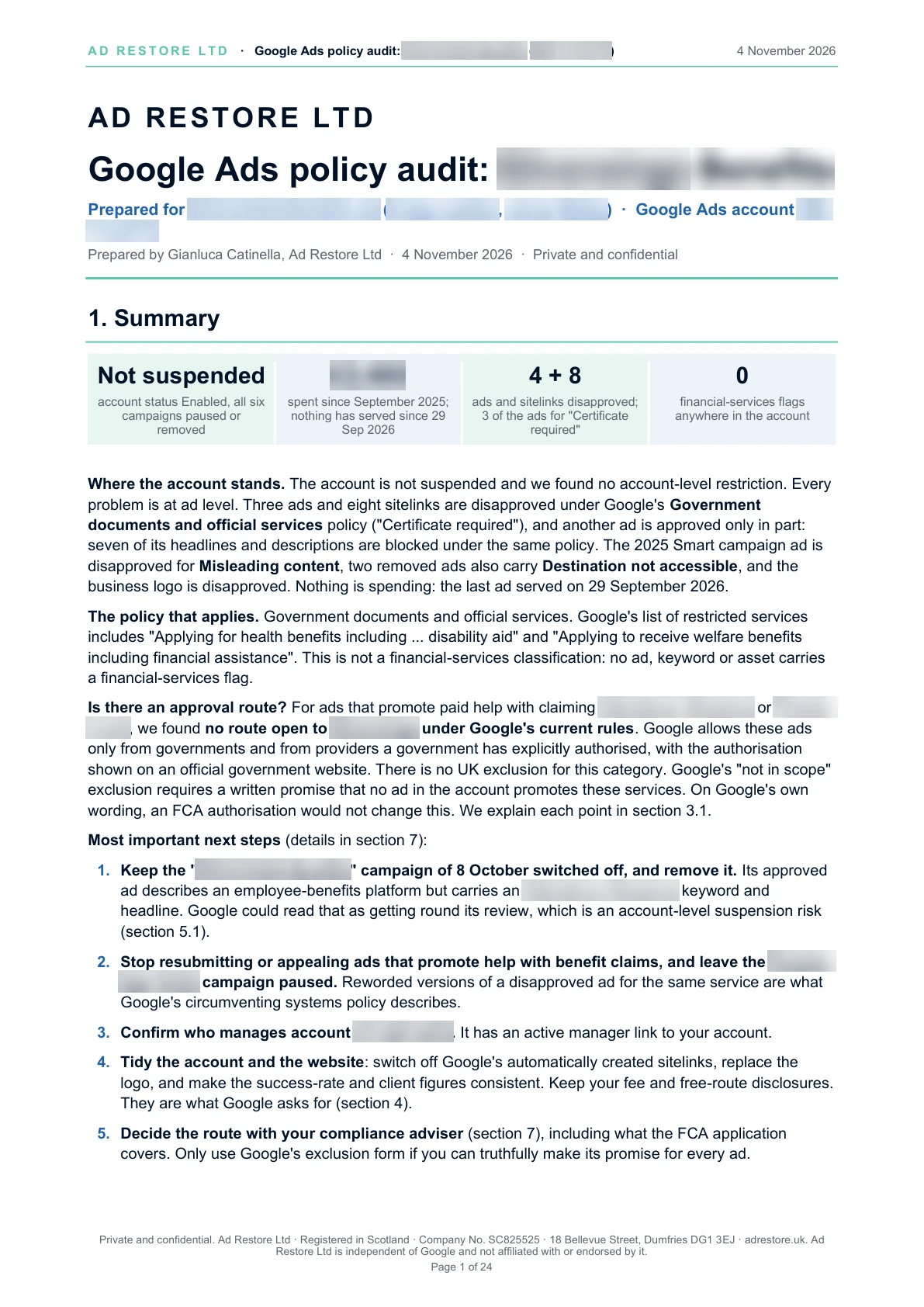
Which policy, and why it isn’t financial services
Every disapproved ad and sitelink but one fell under Government documents and official services. Nothing in the account carried a financial-services flag.
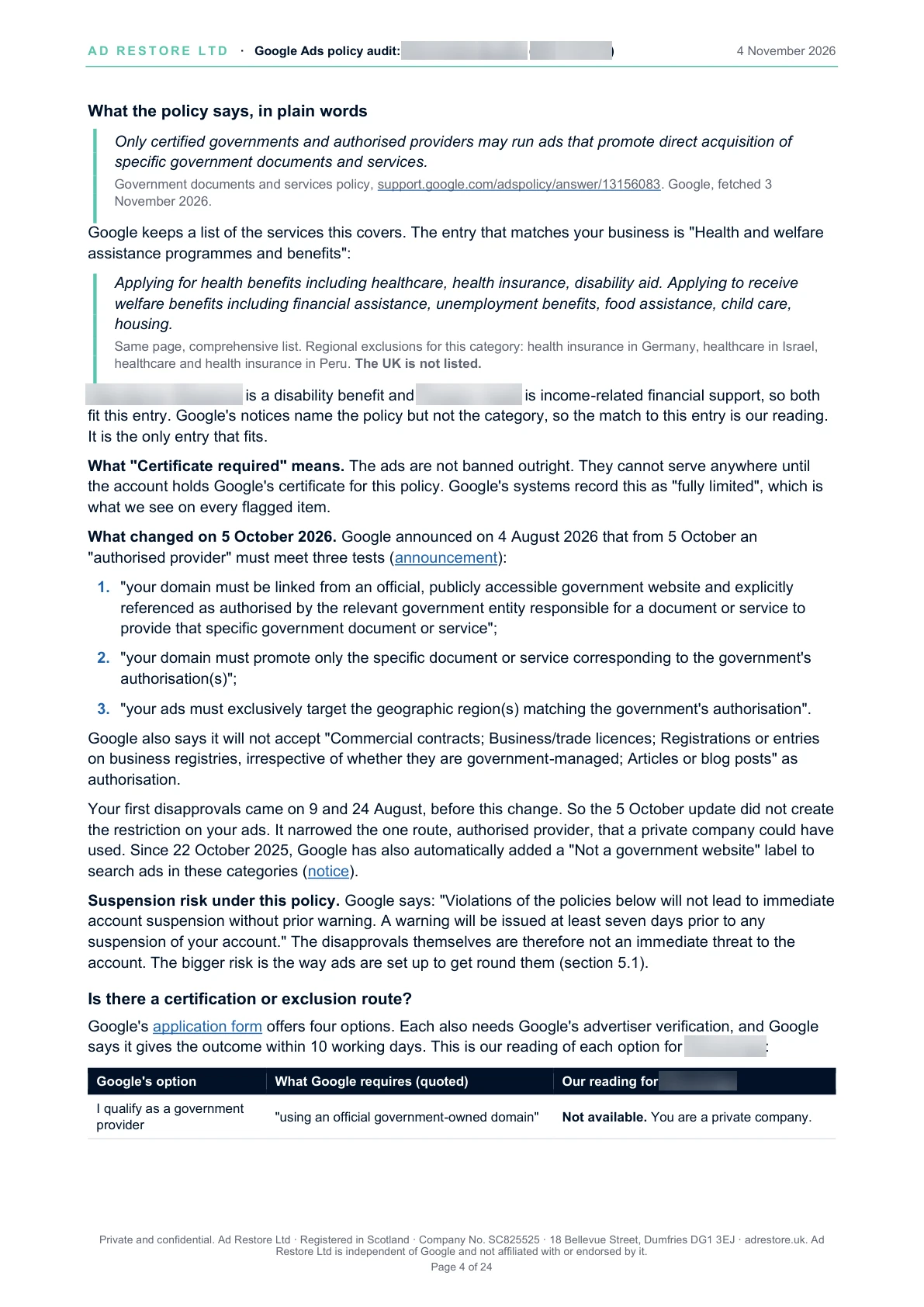
Google’s policy says: “Only certified governments and authorised providers may run ads that promote direct acquisition of specific government documents and services.” Its list of covered services includes, under “Health and welfare assistance programmes and benefits”: “Applying for health benefits including healthcare, health insurance, disability aid” and “Applying to receive welfare benefits including financial assistance, unemployment benefits, food assistance, child care, housing”.
Google’s notices name the policy but not the category, so matching the business to that entry is the report’s reading. It was the only entry that fitted.
What “Certificate required” means
The ads weren’t banned outright. They can’t serve anywhere until the account holds Google’s certificate for this policy.
The disapprovals weren’t an immediate threat to the account either. For this policy Google says: “Violations of the policies below will not lead to immediate account suspension without prior warning. A warning will be issued at least seven days prior to any suspension of your account.”
Is there a certification or exclusion route?
Google’s application form offers four options. The report read each one against the business’s facts:
- A government provider. Not available to a private company.
- An authorised, non-government provider. Since 5 October 2026, Google requires the provider’s domain to be “linked from an official, publicly accessible government website” and named there as authorised for that service. The official pages for the benefits named no private, fee-charging firm, and the report knew of no scheme that authorises paid helpers in this way.
- A regional exclusion. For this category Google lists exclusions only for health insurance in Germany, healthcare in Israel, and healthcare and health insurance in Peru. The UK isn’t one.
- “Not in scope”. Google says: “If your services are purely editorial, educational or consultancy based and do not facilitate the direct acquisition of government documents, you can submit a request for ‘policy exclusion’ by providing a formal warranty.” The promise covers every ad in the account, and the report didn’t think the business could truthfully make it for ads that exist to lead people to its paid claims help.
So, for ads promoting paid help with benefit claims, the report found no route open to the business under Google’s current rules. Only Google decides, but its published text left no route for these ads that we could see.
The first disapprovals came in August, before Google’s 5 October 2026 change, so that change didn’t create the restriction. It narrowed the one route a private company might have used.
Would FCA authorisation help?
On Google’s wording, no. Google needs explicit permission from the government body responsible for the service, shown on an official government website, and it says it won’t accept “Business/trade licences” or “Registrations or entries on business registries” as that permission. A regulator’s authorisation isn’t the same thing.
Where FCA status does matter on Google is UK financial services verification, which applies to financial services ads. The report was clear that this wasn’t legal advice, and that the business’s compliance adviser should confirm what, if anything, needed FCA permission.
Is the wording triggering it?
Partly, but rewording isn’t the fix. The data showed Google’s systems reacting to wording about applying for a benefit, a benefit’s name used on its own as a headline or sitelink, official-sounding keywords and landing pages named after the benefits. The same words were approved in one ad and flagged in another, which suggests Google reads each ad together with its landing page, keywords and campaign.
But the policy restricts the type of service, not particular words. An ad that still promotes paid help with a benefit claim is in scope however it’s worded, and rewording it so the review doesn’t recognise it could count as circumventing Google’s systems. Google’s Circumventing systems policy lists “Bypassing enforcement mechanisms and detection by creating variations of ads, domains or content that have been disapproved for this or any Google Ads policy”, and Google suspends accounts for it “upon detection and without prior warning”.
The biggest risk: one campaign’s set-up
The report’s first recommendation was about one campaign that had never run. Its approved ad described a different kind of product, but it carried a benefits keyword and headline and led to a page about benefit applications.
The report was clear that it wasn’t suggesting anyone meant to get round the review. Its point was that Google judges the set-up, not the intention, and that this campaign was the single biggest risk to the account. It recommended removing it.
Other findings
- Five of the eight disapproved sitelinks had been created automatically by Google from the website’s pages, not by the business.
- The 2025 ad used a success rate as a headline promise, and the website gave a different figure. Google’s Misrepresentation policy covers unreliable claims.
- The website used different figures for the same claims in different places.
- The business logo was disapproved with no reason given. The report’s reading: the name was too small to read once Google shows the logo as a small circle.
- Some old ad addresses no longer existed after a rebuild of the website, and showed “page not found”.
- An unidentified outside account was linked to the account with management access, and the account data didn’t say whose it was.
- The website’s disclosures were already what Google asks for, and the report said to keep them, including the fee.
Google’s guidance for this category asks advertisers to: “Clearly disclose that you are a private entity and not affiliated with any government. If you charge fees for services available for free or less from the government, you must disclose this and provide a link to the official government site.”
Another advertiser’s ads
The business also asked why a similar service’s ads seemed to run. The report described only what was public. Google’s Ads Transparency Center shows that ads were shown, not whether Google approved them in full, limited them, or has reviewed them since. Google doesn’t publish why one advertiser’s ads run and another’s don’t, and its rules give no exception that could be relied on by copying another advertiser’s approach.
What the audit recommended
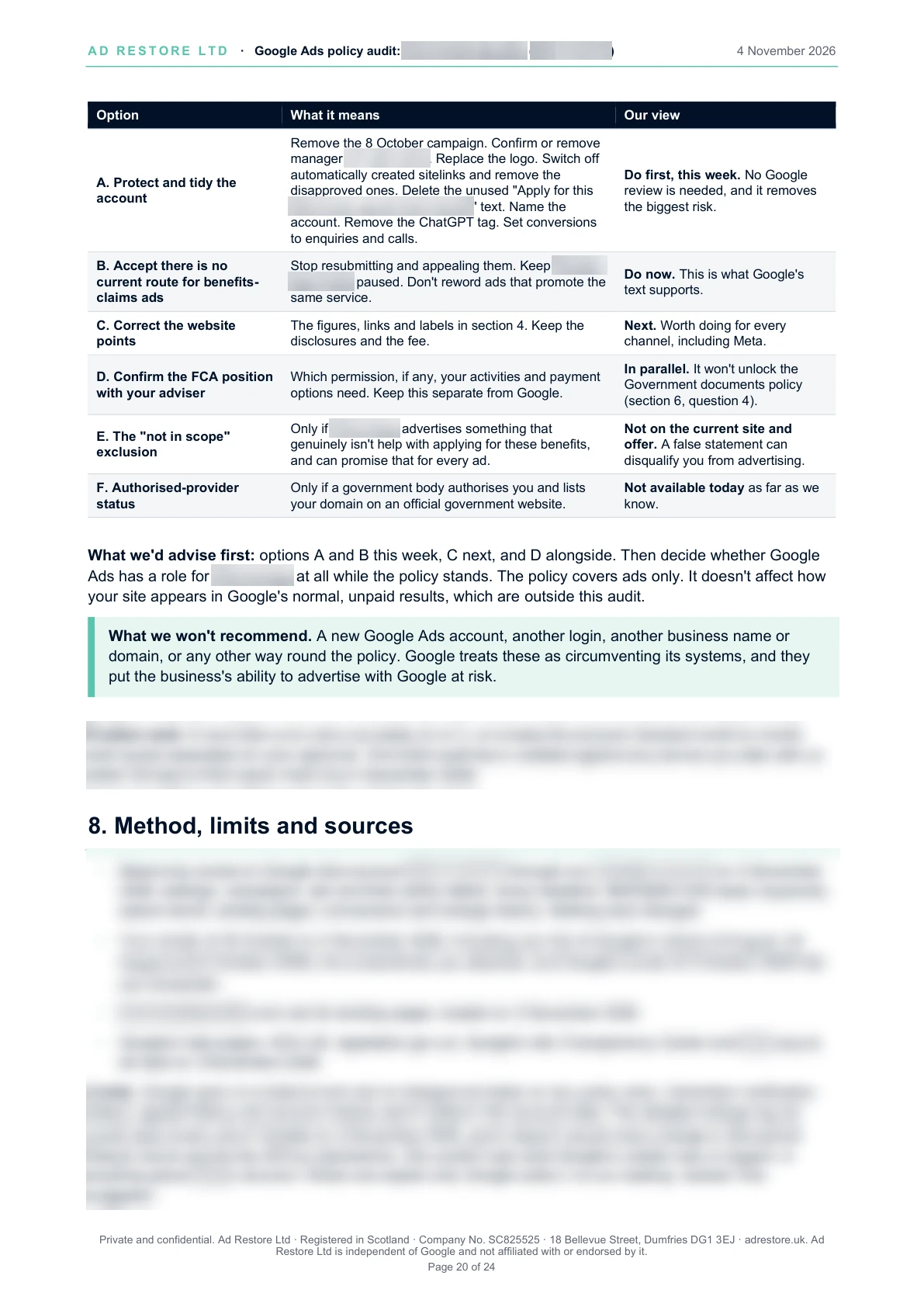
The report set out six options, in the order it would take them:
Protect and tidy the account.
Remove the campaign above, confirm or remove an unidentified linked account, replace the logo, switch off automatically created sitelinks and remove the disapproved ones, name the account, and count only enquiries and calls as main conversions. First, that week: no Google review is needed.
Accept there’s no current route for benefits-claims ads.
Stop resubmitting and appealing them, and don’t reword ads that promote the same service.
Correct the website points.
The figures, links and labels. Keep the disclosures and the fee.
Confirm the FCA position with a compliance adviser.
In parallel, and separately from Google: it won’t unlock this policy.
The “not in scope” exclusion, only if it’s true.
Only if the business advertises something that genuinely isn’t help with applying for these benefits, and can promise that for every ad. Not on the current site and offer.
Authorised-provider status, only if a government grants it.
Only if a government body authorises the business and lists its domain on an official government website. Not available as far as the report knew.
Then, the report said, the business should decide whether Google Ads has a role for it at all while the policy stands. The policy covers ads only: it doesn’t affect how a site appears in Google’s unpaid results.
What it wouldn’t recommend: a new Google Ads account, another login, another business name or domain, or any other way round the policy.
What the business received
- The audit report (PDF, 24 pages, 24 figures). The account, policy by policy; the website; the risks the business might not know about; its questions answered one by one; the route forward; a table of key dates from September 2025 to November 2026; and every Google page it quotes.
- An Excel appendix. Every disapproved ad, asset and sitelink, and Google’s decision on each.
Both went to the business on 4 November 2026.
Where things stand: open
The audit was delivered on 4 November 2026. It advised tidying the account and stopping the appeals first, the website points next, and the FCA question alongside. Which route the business takes, and whether Google Ads has a role for it while the policy stands, is its decision.
That’s what the audit is for. It doesn’t include an appeal, and it changes nothing in the account or on the website. It gives the policy reading, the evidence and the changes to make. Only Google decides what is approved.
What this case shows
- A disapproval isn’t a suspension. The account was enabled; every problem was at ad level.
- Some services have no approval route. When a policy restricts the service itself, no wording, landing page or appeal changes that.
- Rewording is the risk, not the fix. New versions of a disapproved ad for the same service are what Google’s Circumventing systems policy describes.
- A regulator’s authorisation isn’t a government’s permission. For this policy, Google needs the body responsible for the service to name you on an official website.
- Check what Google made for you. Automatically created sitelinks can be disapproved too.
- Keep honest disclosures. Google asks for them.
Don’t open a new Google Ads account, or reword ads, to get round a restriction.
Google treats both as circumventing its systems. Our guide explains why a new account makes things worse.
Questions people ask
What does Google’s Government documents and official services policy restrict?
Its policy says: “Only certified governments and authorised providers may run ads that promote direct acquisition of specific government documents and services.” Its list includes “Applying to receive welfare benefits including financial assistance” and “Applying for health benefits including healthcare, health insurance, disability aid”.
Were the ads disapproved, or was the account suspended?
Only the ads. The account was enabled, with no account-level restriction. For this policy Google says violations “will not lead to immediate account suspension without prior warning”. The bigger risk was the way one campaign was set up.
Can a private company get Google’s certificate for these ads?
Only as an authorised provider, and since 5 October 2026 Google requires the provider’s domain to be “linked from an official, publicly accessible government website” and named there as authorised. In this case the report found no such listing, and no UK exclusion for this category. Only Google decides.
Would FCA authorisation change it?
Not on Google’s wording. Google needs permission from the government body responsible for the service, and it says it won’t accept business or trade licences, or entries on business registries, as that permission. FCA status matters on Google for financial services verification, a separate requirement.
Does the audit include an appeal, or fixing the ads?
No. The audit is the diagnosis: which policy applies, the evidence, whether a route exists, and the changes to make. It changes nothing in the account or on the website. In this case the report advised against appealing ads that promote the restricted service.