Skip to content

Some of your ad impressions have been limited by the Limited Ad Serving policy – Google Ads
 Gianluca Catinella, Director, Ad Restore LtdPublished on 9 min read
Some of your ad impressions have been limited by the Limited Ad Serving policy.
The first line of Google’s Limited Ad Serving appeals form, checked on 4 October 2026. Google’s policy says limited advertisers get an in-account notification and appeal through this form.
This sentence means Google is limiting how often your ads are shown, under its limited ad serving policy. In certain situations, Google says, “only qualified advertisers will be able to serve ads without impression limits”. It isn’t a suspension: Google says individual ads will not be disapproved. In April 2025 it happened to Ad Restore’s own Google Ads account.
The limit was lifted. I believe Google saw our ads as generic: ads about Google Ads, from a company that isn’t Google. After I added Ad Restore branding to the ads, the limit was lifted, though not overnight: it eased gradually over about a week. Below is what happened, what I changed, what Google’s policy says, including its June and August 2026 updates, and what I’d check on any account.
Written from my own Google Ads account and my files from the time: the appeal letter, the appeal form and the account’s change history. Our name is hidden, and the account number shows only its last four digits. Google’s policy page, its June and August 2026 update pages and the appeals form were checked on 4 October 2026; they change without notice.
At a glance
Limited, not suspended
The ads keep running, with fewer impressions. Google says individual ads won’t be disapproved.
Our ads looked generic
I believe Google saw them as generic: ads about Google Ads, from a company that isn’t Google.
Branding was the fix
More headlines carrying the Ad Restore name, with AdRestore.uk as the first headline.
Lifted gradually
After the change, the limit eased over about a week.
Wider from 2026
Google’s August 2026 update covers all Google Ads, rolling out gradually until 2028.
On this page9 sections
What the notice means
Google’s policy page starts with the reason: “Google limits impressions of ads that are more likely to result in negative ads experiences.” The limit applies only in certain ad-serving scenarios, and only to advertisers Google doesn’t yet treat as qualified.
To decide whether an advertiser is qualified, Google says it considers factors such as:
- account attributes;
- user activity and reports;
- account maturity;
- ad format usage;
- history of policy compliance;
- advertiser industry;
- advertiser verification status.
It adds that it takes user reports about that advertiser especially seriously. Advertisers with a meaningful share of impressions in scope get an in-account notification, and can appeal through Google’s Limited Ad Serving appeals form, whose first line is the wording at the top of this page.
What happened to our ads
In April 2025, our own Google Ads account, for Ad Restore Ltd, had its ads limited under this policy.
I believe Google saw our ads as generic. Ad Restore advertises help with Google Ads suspensions, so our services revolve around another company’s product: Google’s. That means our ads need a clear separation between the service, which is about Google Ads, and the company offering it, which is Ad Restore. Ad Restore isn’t affiliated with Google.
Google’s policy describes exactly this risk: “ads that reference other brands and generic ads that have no branding at all may confuse users about the identity of the advertiser”. In those cases, it says, it may limit impressions on certain searches for all of that advertiser’s branded and generic ads.
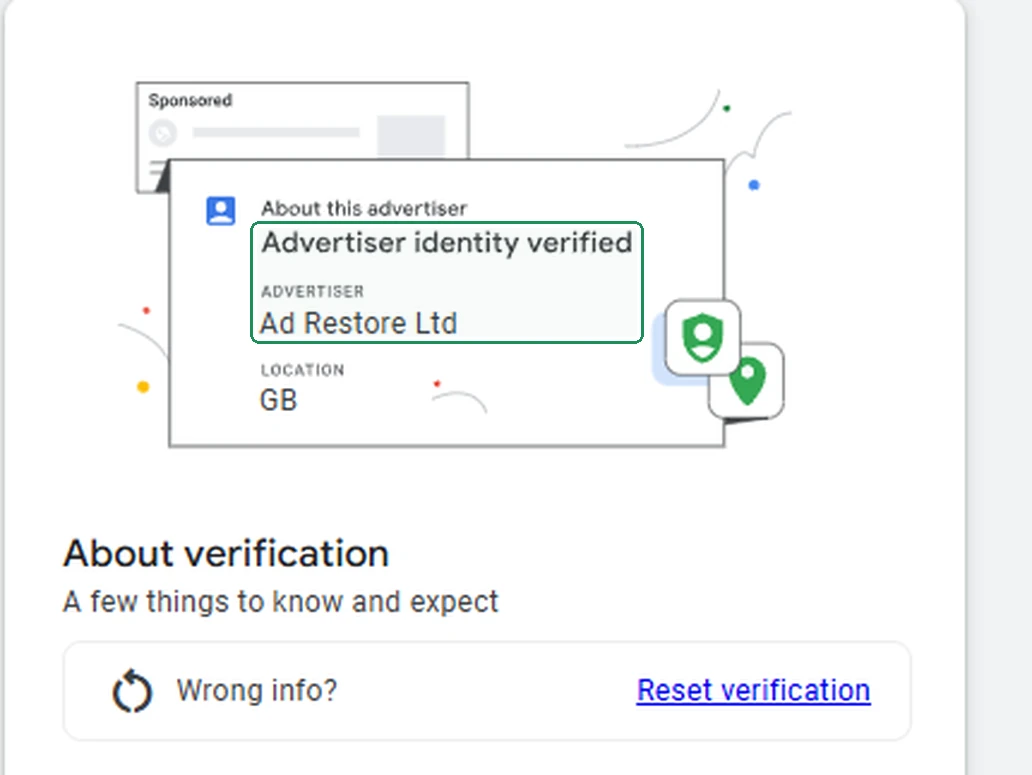
Our account was already verified as Ad Restore Ltd when its ads were limited. Verification is one of the factors Google weighs, but it’s only one: the ads themselves still have to make clear whose they are.
What I changed
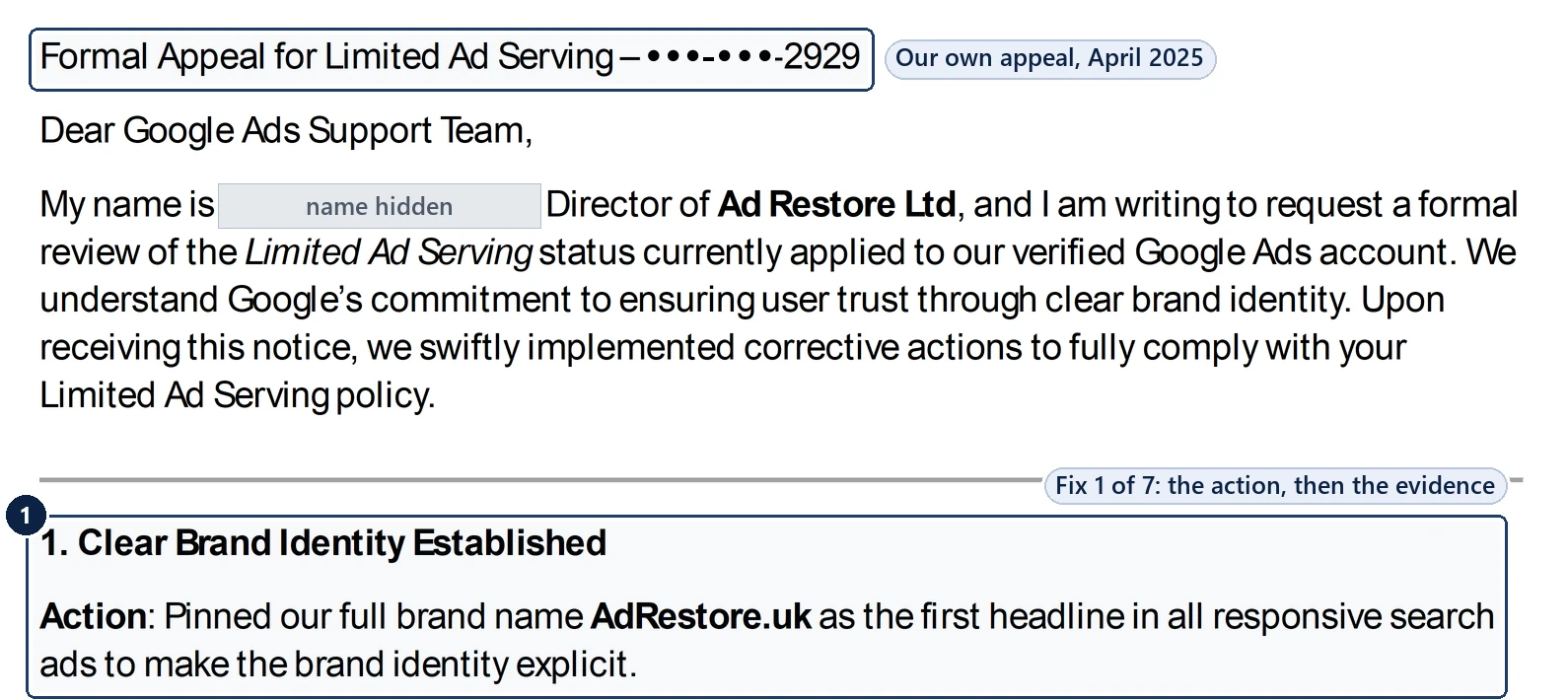
I added Ad Restore branding to the ads: more headlines carrying the Ad Restore name, so every ad said whose it was. Our full brand name, AdRestore.uk, went in as the first headline of our responsive search ads, which is one of Google’s own suggestions: “Pin your domain to the front of the ad title”. Old campaigns were removed.
I also set the changes out for Google on its Limited Ad Serving appeals form, with a formal letter attached. The letter opened with the request for a review, then listed each change as an action followed by its evidence:
How the limit lifted
It wasn’t instant. After the branding change, the limit eased gradually over about seven days. There was no single moment when it switched off:
They may accept it and it doesn’t happen automatically, just over time it changes.
Gianluca CatinellaDirector, Ad Restore LtdThat fits how Google describes it. “Google Ads will automatically update your ad serving limits based on this assessment and review”, and on timing, Google can’t say how long this might take. It also warns that if any issues are detected after lifting a limit, it may put the limit back while it looks again.
What changed in June and August 2026
Google has widened this policy twice in 2026. Its June 2026 update, posted on 3 June, extends the policy to cover additional scenarios on Google Search. Its new Search section says Google may limit impressions from unqualified advertisers “on searches that are more likely than others to result in negative ads experiences”, and repeats the point about branding: ads that reference other brands, and generic ads with no branding, may confuse people about who the advertiser is.
The August 2026 update goes further: Google says it will update the policy to cover all Google Ads, with best practices for Search and for YouTube, Gmail, Play Store and Discover. For both updates, Google says implementation will begin gradually and will be completed by 2028.
So an account that has never seen this notice may still see it as the rollout continues. Ours was limited in April 2025, before either update.
What I’d check if your ads are limited
- Your own brand, everywhere. Google’s advice is to clearly display your own brand in your ads and on your landing page.
- Say whose product it is. If your service revolves around another company’s product, as ours does with Google Ads, Google asks you to be clear about your association with them and keep your own branding clear.
- Pin your domain. Google suggests pinning your domain to the front of the ad title, especially if you’re a new advertiser or your brand is less well known. In a responsive search ad, select the Pin icon on the headline that holds your domain and choose “Show only in position 1”.
- No generic copy. Google: “Use specific language: Avoid generic ad copy and landing page content.”
- Advertiser verification. Google lists it among its best practices, and verification status among the factors it weighs. Ours was already done, so on its own it wasn’t enough.
The appeals form
Google’s appeal route is its Limited Ad Serving appeals form. It asks for:
- the customer ID of the limited account, not your manager account’s;
- a contact name and email, and the name of the company being advertised;
- which restriction you’re appealing: “Restrictions on Google Ads” or “Restrictions on Display”;
- your website;
- whether you’re advertising your own business, managing accounts for clients, an affiliate, or something else;
- a short description of the business and a summary of the issue, up to 1,000 characters each, with an optional attachment.
Google says a specialist will be assigned to your case, that it expects to respond within five working days, “though sometimes it can take a bit longer”, and that the account will be released from the temporary limited state if the appeal is successful. Change the ads first, then appeal: our guide to what a strong appeal contains applies here too.
Don’t open a second account to get round it.
Google’s Circumventing Systems policy says: “Attempting to use multiple accounts to get around those policies is not allowed.” Fix the branding in the account you have, and let Google reassess it.
Frequently asked questions
What does “Some of your ad impressions have been limited” mean?
It’s the first line of Google’s Limited Ad Serving appeals form. Google is limiting how often your ads are shown under its limited ad serving policy, which lets only qualified advertisers serve ads without impression limits in certain scenarios. Your ads keep running, with fewer impressions.
Is limited ad serving a suspension?
No. A suspended account can’t run any ads. Under limited ad serving the ads keep running, but Google limits their impressions, and it says individual ads will not be disapproved. Our guide to why a Google Ads account is suspended covers suspensions.
How do you get limited ad serving lifted?
Google says you become a qualified advertiser by complying with its policies, completing advertiser verification if your account is eligible, and building campaigns with positive user engagement; it then updates your limits automatically. On Search, its best practices are about branding: your own brand clearly in the ads and on the landing page, your association with other brands made clear, and your domain pinned to the front of the ad title. In our case, the limit lifted after I added Ad Restore branding to the ads.
How long does limited ad serving last?
Google says it reviews and updates limits as it monitors accounts, and can’t say how long this might take. On our own account, the limit eased gradually over about a week after the branding change. That’s one case, not a timescale anyone can promise.
How do you appeal limited ad serving?
Through Google’s Limited Ad Serving appeals form. Google says a specialist is assigned and it expects to respond within five working days, though sometimes it can take a bit longer. Make the changes to your ads before you send it.
What changed in the limited ad serving policy in 2026?
Google’s June 2026 update extends the policy to more scenarios on Google Search, and its August 2026 update extends it to all Google Ads, including YouTube, Gmail, Play Store and Discover. Google says implementation will begin gradually and will be completed by 2028.
Does Ad Restore help with limited ad serving?
It isn’t one of our listed services, but we’ve been through it on our own account. If your ads are limited for this, book a free consultation or send us a message. Ad Restore Ltd is independent of Google, and only Google decides how an account’s ads are served.