Skip to content

Circumventing Systems after around two years: a florist’s Google Ads account reinstated – a case study
 Gianluca Catinella, Director, Ad Restore LtdPublished on 7 min read
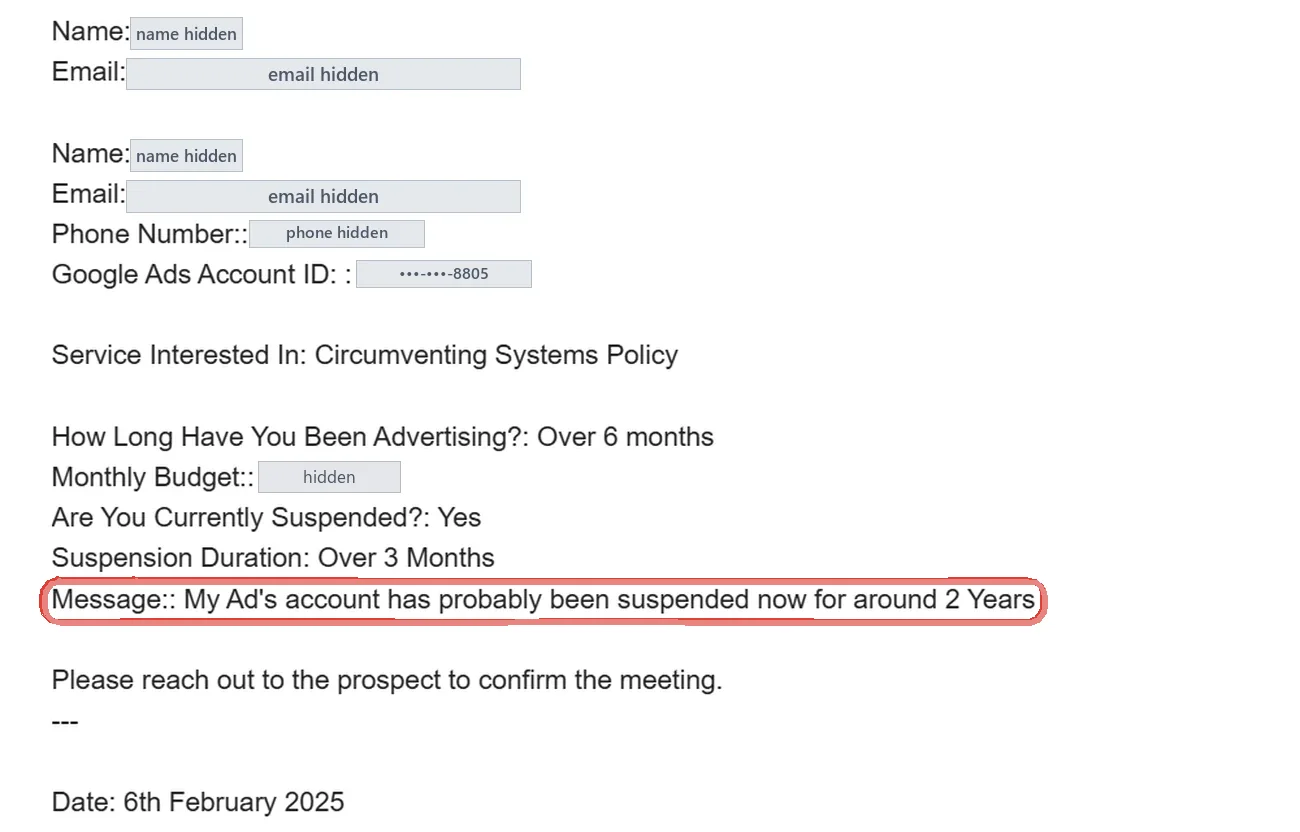
My Ad's account has probably been suspended now for around 2 Years
The message on the enquiry form she sent us on 6 February 2025, quoted word for word. She had chosen Circumventing Systems as the policy.
This is a real case: Flowers by Bethany, a florist in Greater Manchester. Its Google Ads account had been suspended under the Circumventing Systems policy for around two years when she contacted us in February 2025. The website was the obstacle: its redirects, and security plugins that block bots, meant Google couldn’t check it. Once she’d fixed those, a properly built appeal went in and the account was reinstated. In her own words, it was “back up and running in under 2 weeks”.
She had corrected the original problem years earlier, but had never appealed properly. She wanted the account back for Mother’s Day and the other big dates in a florist’s year. Today the account is still active, and she runs her seasonal promotions from it.
Written from our case files: her enquiry, our checks of the website, the account’s screens and her Google review, with their dates. Her name, email address, phone number, website address and budget are hidden, and the account number shows only its last four digits. The Google pages linked here were checked on 4 October 2026.
At a glance
Circumventing Systems
Suspended for around two years, by her own estimate, when she got in touch on 6 February 2025.
Google couldn’t check the site
Redirects and security plugins that block bots kept Google’s crawlers out.
“Compromised site”, not hacked
An ad was disapproved under that label on 19 February 2025. Nothing had been hacked.
Back in under two weeks
Her words, in her Google review of 16 April 2025. The account is still active.
One case, not a promise
Every account is different, and only Google decides.
On this page8 sections
Where it started
On 6 February 2025 she filled in the enquiry form on our website. She chose Circumventing Systems as the policy, and in the message box wrote that the account had “probably been suspended now for around 2 Years”.
Google says violations of its Circumventing Systems policy are taken very seriously and are considered egregious, and that accounts are only reinstated in compelling circumstances, such as in the case of a mistake.
She had corrected the original problem years before she contacted us. What had never gone in was a proper appeal. She went ahead with us on 21 February 2025.
What we found on the website
On the day of her enquiry, an outside check of the homepage came back “200 OK”: the page was served, and to a person in a browser the site looked fine.
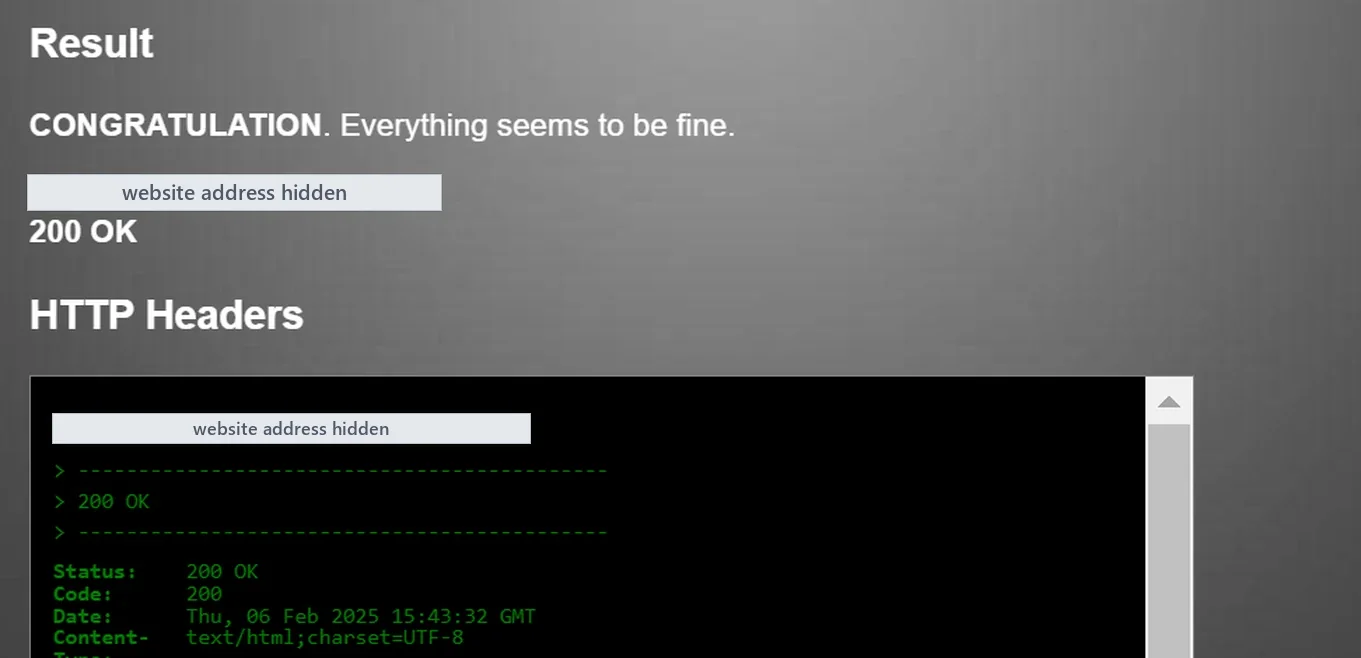
That wasn’t the whole picture. The site was custom-built, and between its redirects and the security plugins blocking bots, Google couldn’t check it. We found both problems with our own tools.
That matters under this policy. One of Google’s best practices for Circumventing Systems is to make sure that Google can easily see all the pages on your website, and its tips for an appeal mention steps like removing redirections.
“Compromised site”, though nothing was hacked
On 19 February 2025 an ad in the account showed as disapproved under “Compromised site”.
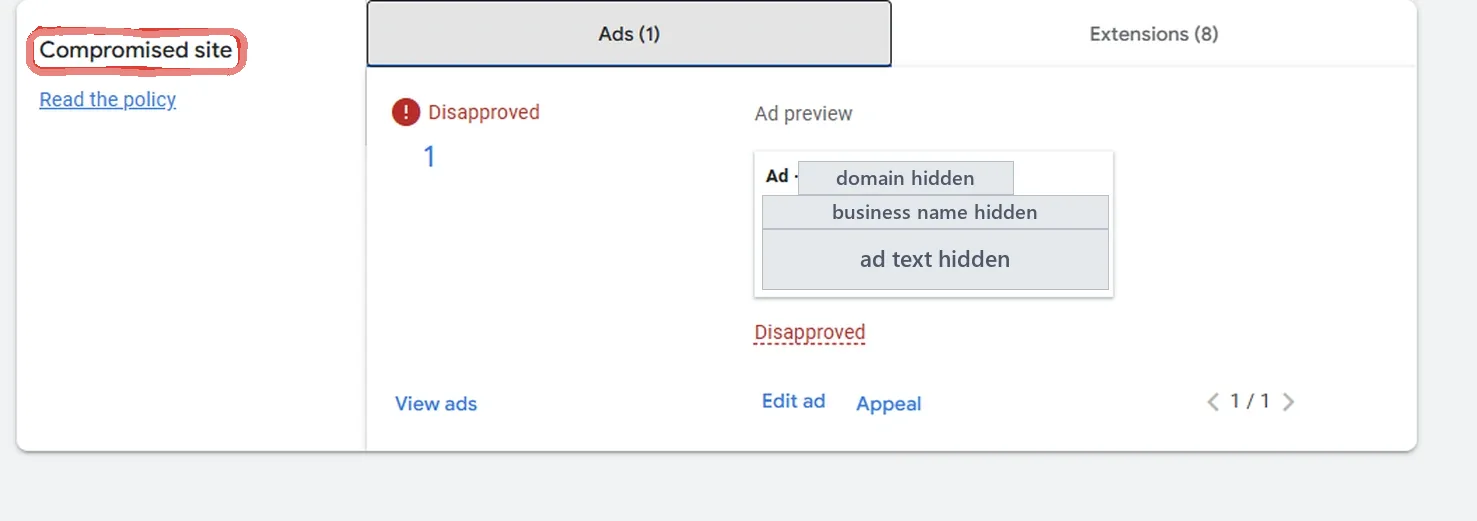
Google describes a compromised site as one whose code has been manipulated to act in ways that benefit a third party, without the owner knowing. That isn’t what had happened. Nothing on the site had been hacked: the same redirects and bot-blocking plugins meant Google couldn’t check it.
Once the site was fixed, we contacted Google support about the ad together with her, and after about five days it was approved. Our guide to the “Compromised site” disapproval covers that label on its own.
What changed, in order
Find what Google can’t see
We checked the site with our own tools and found the redirects and the security plugins blocking bots.
Fix the site first
She fixed the redirects and the bot blocking, so the site’s content was readable for Google’s crawlers.
Then appeal
A properly built appeal went in only after that.
The result
The account was reinstated, and it’s still active: she runs her seasonal promotions from it. Our files don’t hold a dated reinstatement email for this case, so we don’t give a date. Her Google review gives the timescale, in her words.
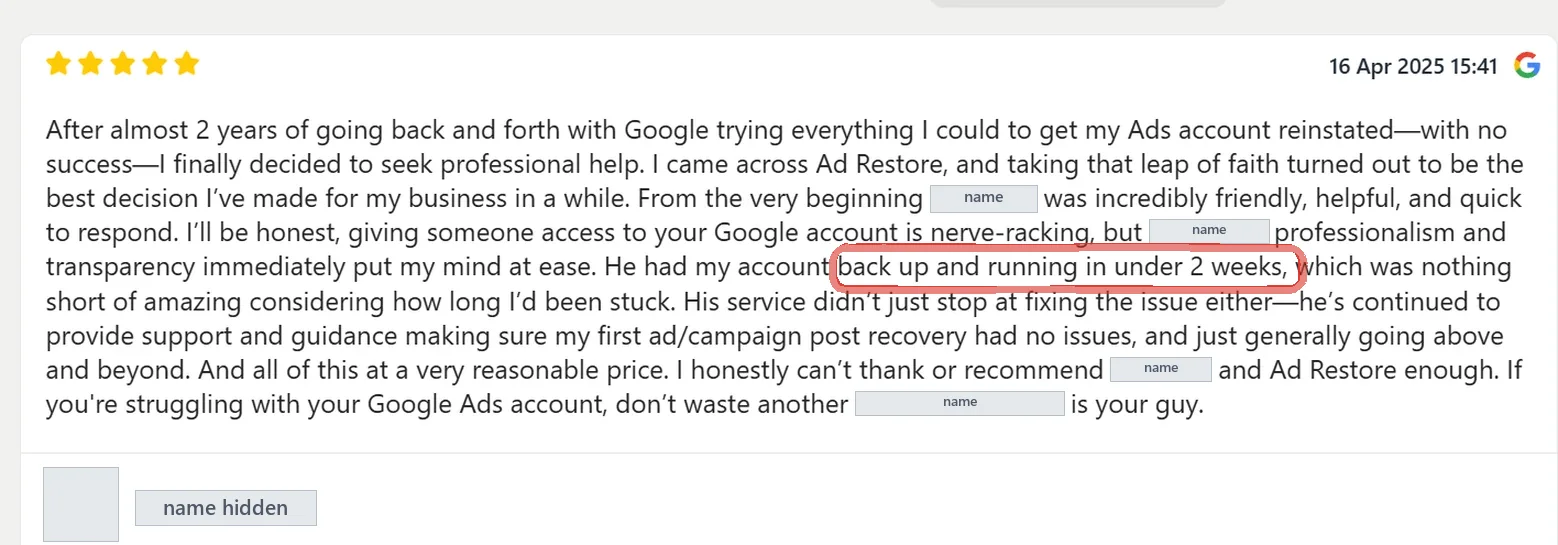
After almost 2 years of going back and forth with Google trying everything I could to get my Ads account reinstated—with no success—I finally decided to seek professional help.
… I’ll be honest, giving someone access to your Google account is nerve-racking … He had my account back up and running in under 2 weeks, which was nothing short of amazing considering how long I’d been stuck. His service didn’t just stop at fixing the issue either—he’s continued to provide support and guidance making sure my first ad/campaign post recovery had no issues …
After the reinstatement she had our support with her first campaign. Every service we sell now includes 14 days of post-reinstatement support.
What this case shows
- “Loads fine” isn’t the same as “Google can check it”. The homepage answered 200 OK to an outside check, while redirects and bot-blocking security plugins kept Google out.
- Fixing the problem isn’t the same as appealing. She had corrected the original problem years earlier, but without a proper appeal the account stayed suspended.
- Fix first, then appeal. The appeal went in once the site’s content was readable for Google’s crawlers.
- A label isn’t a diagnosis. “Compromised site” appeared on an ad, but nothing had been hacked.
- Don’t wait two years. This account came back, but Google only says that all advertisers have at least six months from the date of account suspension to submit an appeal.
Don’t open a new Google Ads account to get round this.
Google says accounts related to the suspended account may be suspended, and “any new accounts that the advertiser tries to create may also be suspended”. Its Circumventing Systems policy names creating new accounts to re-enter the system after a suspension as a violation. Read why a new account makes things worse.
Questions people ask
Can a Google Ads account that’s been suspended for two years be reinstated?
This one was: it had been suspended for around two years when she contacted us, and it was reinstated. Google says all advertisers have at least six months from the date of account suspension to submit an appeal, so don’t leave it that long if you can help it. One case is not a promise; only Google decides.
Why did Google say “Compromised site” when the site wasn’t hacked?
Here, the custom-built site’s redirects and security plugins blocking bots meant Google couldn’t check it, and an ad was disapproved under “Compromised site”. Once the site was fixed, we contacted Google support about the ad with her, and it was approved after about five days. Our guide to the “Compromised site” disapproval explains the label.
How long did it take?
In her Google review she says the account was “back up and running in under 2 weeks”. Our files don’t hold a dated reinstatement email for this case, so we don’t give an exact date. That’s one case, not a timescale anyone can promise.
What did she have to change?
The redirects and the bot blocking on her custom-built site, so that its content was readable for Google’s crawlers. We found both problems with our own tools, she made the changes, and only then did the appeal go in.
She had already fixed the original problem. Why was the account still suspended?
Because a fix on its own doesn’t lift a suspension. She had corrected the original problem years earlier but had never appealed properly. Google reviews an appeal; in Google Ads, you start one from the Contact us link in the notification at the top of your screen.