Skip to content

Circumventing Systems: first appeal rejected, second appeal accepted – a case study
 Gianluca Catinella, Director, Ad Restore LtdPublished on 4 min read
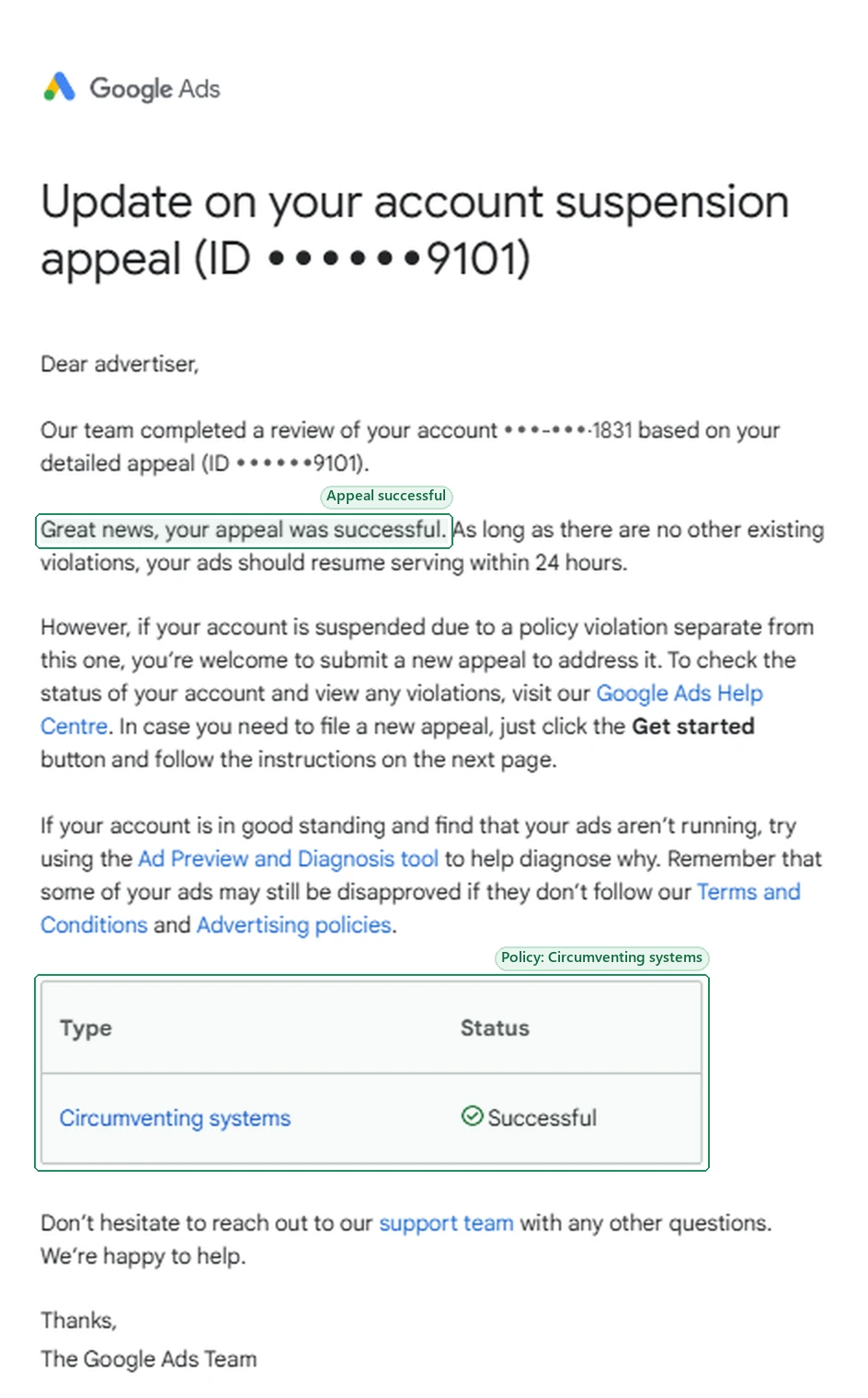
Great news, your appeal was successful.
Google Ads’ reply to the second appeal, November 2024. The table under it reads “Circumventing systems: Successful”.
This is a real case. In November 2024 an Australian food business that sells online had its Google Ads account suspended under the Circumventing Systems policy. The first appeal was rejected. The second, sent with the identity documents of the person who had actually set up the account, was accepted.
Both appeals went in during November 2024. Our files run from 10 November, when the first appeal’s evidence was gathered, to 16 November, when Google emailed to say the account had been reactivated. We’re not naming the business.
Written from our case files: the appeals, the evidence lists and Google’s replies, with their dates. The business’s name, its account and appeal IDs and its documents are hidden. The Google pages linked here were checked on 4 October 2026.
At a glance
Circumventing Systems
The suspension named Google’s Circumventing Systems policy.
First appeal: rejected
The identity documents were for a different family member, not the person who set up the account.
Second appeal: accepted
With the documents of the person who actually set up the account. Google: “Great news, your appeal was successful.”
About a week
Our files run from 10 to 16 November 2024.
One case, not a promise
Every account is different, and only Google decides.
On this page7 sections
The suspension
Google says violations of its Circumventing Systems policy are taken very seriously and are considered egregious, and that accounts are only reinstated in compelling circumstances, such as in the case of a mistake.
The business sold through its own website, had a Merchant Center account linked to Google Ads, and was running a Performance Max campaign.
The first appeal
The first appeal was written into the three parts of the appeal form in Google Ads, with a formal letter alongside. The evidence it pointed to was technical, plus proof of ownership:
- a redirect check showing that the website’s address answered normally;
- the domain’s DNS settings;
- a page-speed test from 10 November 2024;
- the Merchant Center account, shown as verified and claimed;
- the domain registration certificate and the company’s registration.
It was rejected, and what it got wrong was the identity documents. They were for a different member of the family, not for the person who had originally set up the Google Ads account.
What changed for the second appeal
The second appeal, on 14 and 15 November, supplied the identity documents of the person who had actually set up the account. It was also rewritten from the start, with a new summary of the issue and a new formal letter. With it went:
- a training schedule;
- a bank statement and the domain purchase invoice;
- Google’s business operations verification form, filled in on 14 November and showing as pending;
- a request through Google’s Help Centre, sent from our address as the business’s agency, asking for the account to be reactivated, with more evidence added to the case.
The result
Google’s reply: “Great news, your appeal was successful. As long as there are no other existing violations, your ads should resume serving within 24 hours.” The table under it lists the policy, Circumventing systems, with the status Successful.
A separate Google email, “Your Google Ads account has been reactivated”, arrived early on 16 November 2024.
What this case shows
- Send the documents of the person who set up the account. Here, a family member’s documents went with the first appeal and it was rejected; the second appeal carried the account holder’s own documents and was accepted.
- A rejection isn’t the end. Google lets you appeal again from the Contact us link in the notification at the top of your screen. Our guide to a rejected appeal covers what to change first.
- The second appeal was a different appeal. It wasn’t the first one sent again: the documents changed and the explanation was rewritten.
- One appeal at a time. Google says “submitting one appeal at a time ensures timely response and review”.
Don’t open a new Google Ads account to get round this.
Google says accounts related to the suspended account may be suspended, and “any new accounts that the advertiser tries to create may also be suspended”. Its Circumventing Systems policy names creating new accounts to re-enter the system after a suspension as a violation, and that policy is egregious too. Read why a new account makes things worse.
Questions people ask
Why was the first appeal rejected?
The identity documents sent with it were for a different family member, not the person who had originally set up the Google Ads account. The second appeal supplied the documents of the person who had actually set up the account, and Google accepted it.
Can you appeal again after a Circumventing Systems appeal is rejected?
Yes. In Google Ads, select the Contact us link in the notification at the top of your screen; it opens the appeal form. Change what the first appeal got wrong before you send the next one.
How long did the second appeal take?
Our files show the second appeal prepared on 14 and 15 November 2024 and Google’s reactivation email on 16 November. That’s one case, not a timescale anyone can promise.