Skip to content

If you have new information to support your original appeal, proceed to file a re-appeal – Google Ads
 Gianluca Catinella, Director, Ad Restore LtdPublished on 7 min read
Your account is suspended. Your appeal filed on [date] for [policy] was rejected. If you have new information to support your original appeal, proceed to file a re-appeal.
This is the wording one advertiser reported on the Google Ads Community in March 2026. Their appeal date and policy (Unacceptable business practices) are replaced here with [date] and [policy].
A rejected appeal means Google has reviewed your appeal and the account stays suspended. Google’s suspensions overview says a suspension is considered permanent unless the appeal is submitted and the account is successfully reinstated. It also says that if your appeal is rejected, you can re-appeal following the same process.
Google says that when your appeal is reviewed, you’ll receive an email with the outcome. The rejection message that advertiser posted names the policy and the appeal date, but not what was wrong.
Checked against Google’s help pages on 22 September 2026. Google changes them without notice, so check the linked page before relying on a detail.
At a glance
Still suspended
Google treats a suspension as permanent unless an appeal succeeds.
You can re-appeal
Google says you can, following the same process as before.
One appeal at a time
Google may not process too many appeals for the same suspension.
Find what was missed
In our experience, the next appeal starts with a process of elimination.
No new accounts
Google says new accounts may also be suspended.
On this page7 sections
Why it was rejected is a separate question
Our guide to why Google Ads appeals get rejected covers the reasons appeals fail. This page picks up once the rejection has landed: what Google lets you do next, and how we work out what goes into the next appeal. Still waiting for a decision? See what the appeal-received email means. Rejected within hours? See what a fast rejection usually means, and how to check whether Google fetched your pages.
What Google allows next
- Re-appeal the same way. In Google Ads, select the Contact us link in the notification at the top of your screen. It opens the appeal form.
- One appeal at a time. If you file too many appeals for the same account suspension, Google says “we may not process them”, and that “submitting one appeal at a time ensures timely response and review”.
- Fix the issue first. The account suspension appeal form we’ve checked warns: “Submitting multiple appeals within a 7-day period, without fixing the issue they relate to, may result in your appeals being flagged as unfounded and limit your ability to submit new appeals.”
- Check every related account. Before appealing, Google asks you to ensure that all linked (or previously linked) and all related accounts comply with its policies.
- Explain, and be thorough. Google asks you to include any relevant information and an explanation of why you believe the suspension is incorrect, and to take the time to be thorough.
- Verify if asked. Some advertisers must complete advertiser verification successfully before they can appeal, and Google limits failed verification attempts.
None of the Google pages we checked says what counts as “new information”.
Google has two seven-day rules on appeals, and neither is a set wait after a rejection. Its overview says that if we have indications that you are misusing our appeals function, “we will suspend processing of certain appeals for seven days”. The form’s warning is about several appeals within seven days without fixing the issue.
Our process of elimination
We cover the basics in our first appeal on a case: every base we know from previous cases. So when one of ours is rejected, there’s something new we’ve missed, and the second appeal is about finding it. Our starting point is to review the first appeal:
- What was done, and what wasn’t.
- Where it could be strengthened, and what else could bolster it.
- What new information has come to light.
- If everything else has been covered, what’s left.
Then we diagnose the account from head to toe, looking for the underlying issue that’s still keeping it suspended. What does this case have that previous cases didn’t? That’s the smoking gun. In our experience, sometimes it follows a pattern we’ve seen before. Sometimes it’s something new, and then it adds to what we know, so we can help future clients with a similar issue.
In our experience, you can normally get to a more positive result through that process. That isn’t a promise or a success rate. Google says accounts are only reinstated in compelling circumstances, and only Google decides.
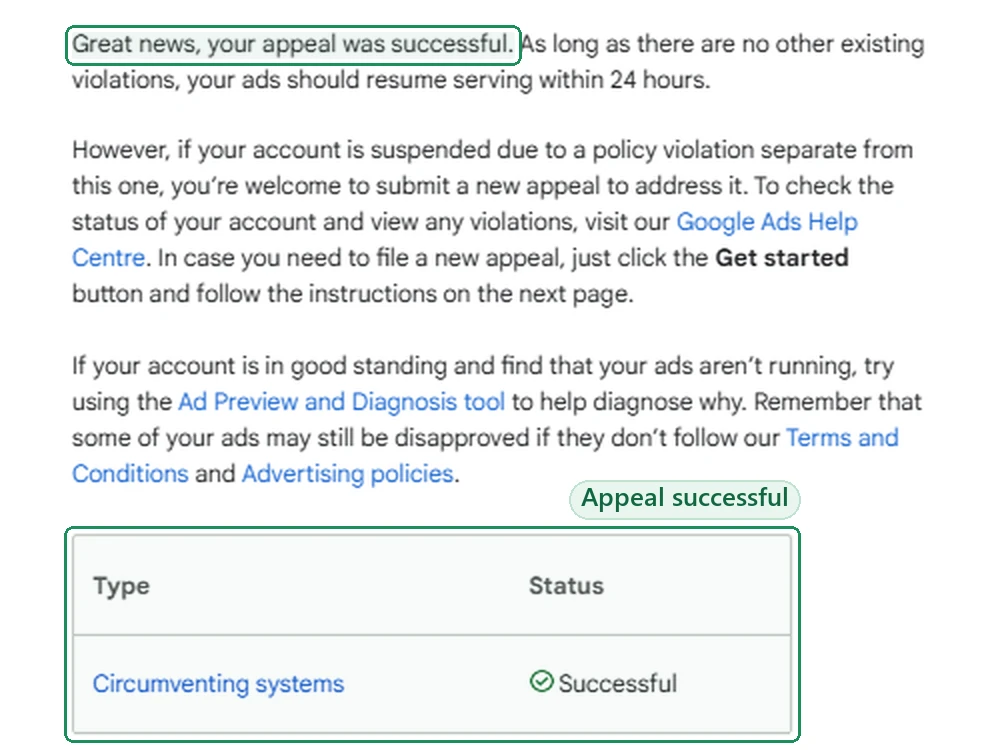
One real case: in November 2024 an Australian food business’s account was suspended for Circumventing Systems, and its first appeal was rejected. The second appeal was rewritten, with more evidence, and Google accepted it.
Re-appealing, step by step
Read the rejection.
Note the policy it names, and don’t send the same appeal straight back.
Review the appeal that failed.
What it said, what it left out, and what evidence went with it.
Diagnose the account and fix what you find.
Include every linked, previously linked and related account, as Google asks.
Complete verification if Google asks for it.
Some advertisers can’t appeal until they have.
Send one new appeal.
From the notification in your account, with the new information and the evidence behind it. Here’s what the appeal form asks.
Wait for the outcome email.
Google’s in-review message says you can’t submit additional appeals during the review.
Can it still be fixed?
Sometimes it can’t. Google’s line on egregious policies, such as Circumventing systems and Unacceptable business practices, is hard: You will not be allowed to advertise with us again. Its overview still points to tips for what to include in your appeal against them.
Our guide to when a suspension can’t be fixed lists the fatal flaws we name at the free consultation rather than bill you to discover. Appeals already refused aren’t among them: our guide lists them as difficult, and we still take them on, with expectations measured honestly first.
Don’t open a new Google Ads account to get round a rejection.
Google says any new accounts that the advertiser tries to create may also be suspended. Its Circumventing Systems policy, which Google treats as egregious, names creating new accounts to re-enter the system after a suspension as a violation. Read why a new account makes things worse.
Frequently asked questions
Can I appeal again after my appeal is rejected?
Yes. Google says that if your appeal is rejected, you can re-appeal following the same process. Its overview doesn’t give a limit on how many times, but says it may not process too many appeals for the same suspension. Send one at a time, and fix what you find first.
Do I have to wait seven days before I re-appeal?
Not that we’ve found. Google’s seven-day pause applies when it sees signs of misuse, and the appeal form’s warning is about several appeals within seven days without fixing the issue. Neither sets a fixed wait after a rejection.
Why won’t Google tell me exactly what’s wrong?
The rejection message one advertiser posted on the Community names the policy, not what was wrong, and we haven’t found a Google page that promises more detail. In our experience, the next appeal is a process of elimination: rule out what’s been covered, then find what’s left.
Can I ask for a person to review it?
The Google pages we checked don’t offer a separate way to ask Google for one. Google’s route is the appeal, sent from the notification in your account.
How long do I have to appeal again?
Google gives advertisers at least six months from the date of account suspension to submit an appeal, and doesn’t say how that applies to a re-appeal. It also says advertisers may not be able to access suspended accounts after an extended period, so don’t leave it.
Should I open a new account instead?
No. Google says new accounts a suspended advertiser tries to create may also be suspended. Work on the account you have.